Subject: warrior
Setting: US-Apache wars, American Southwest 1854-1886
Evolution:
Context (Event Photos, Primary Sources, Secondary Sources, Field Notes)
* The Chiricahua Apache and their struggle for freedom online
"In the early 18th century, the Spanish sought to establish missions and control over the territories inhabited by the Chiricahua. This led to conflicts as the Apache resisted attempts to subjugate their people and convert them to Christianity. The Spanish often employed brutal tactics to quell resistance, which only heightened the animosity between the two groups.
"By the 19th century, the landscape of power dynamics had shifted again with the arrival of American settlers following the Mexican-American War. The Treaty of Guadalupe Hidalgo in 1848 ceded large portions of land from Mexico to the United States, further encroaching on Apache territories. The Chiricahua faced increasing pressure from settlers who sought to exploit the land and resources, leading to violent confrontations known as the Apache Wars.
"During this period, the Chiricahua Apache, under the leadership of notable figures such as Geronimo and Cochise, fought fiercely to maintain their sovereignty. Their resistance was characterized by guerrilla warfare tactics, demonstrating their deep understanding of the rugged terrain, which they used to their advantage against better-armed forces.
"These encounters significantly impacted the Chiricahua Apache’s social, political, and economic structures. As their traditional lands were encroached upon, they were forced to adapt to new realities while striving to preserve their cultural identity. This struggle laid the foundation for their ongoing fight for freedom and autonomy, which would define their history for decades to come."
* Paterek 1994 p156
"The Chiricahua Apache live around the southern New Mexico/Arizona border and into Mexico. They were composed of three bands: (1) the eastern or 'red paint people,' so-called because warriors painted a red band across the face; (2) the central or 'Wild Apaches'; (3) and the southern or 'Enemy Apaches.' These bands all fought unceasingly against the Spanish and carried on a bitter war of revenge with U.S. troops from 1848 to 1886 when Geronimo, the last holdout, surrendered. Highly mobile hunters, raiders, and gatherers, the Chiricahua Apache did no farming; indeed, the different bands were seldom in one place long enough to have planted or harvested crops. Deer and pronghorn antelope were extremely important game animals, not only for food but also for their hides, which were made into rawhide and tanned skins for clothes. Chiricahua is an Apache term for 'great mountain.'"
Costume (Headdress, Jewelry, Shirt, Boots)
* Paterek 1994 p156
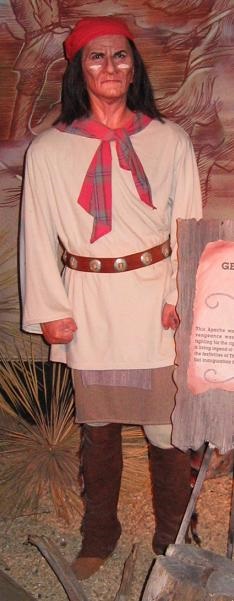
"Early garments were of tanned skin -- a breechclout, which was sometimes a kilt shape rather than a fitted clout, a poncho, and simple leggings. Since they lived near the Mexican border, frequently escaping across it, it is little wonder that the Chiricahua adopted and clung to the Mexican style of clothing, especially the men. The situation is further complicated by the fact that little is known about very early clothing of the Chiricahua, and it is not known when they first began wearing Mexican-style clothes. What lingers in the mind are the photographs of the fighters taken during the height of the bloody conflicts of the nineteenth century. These men usually wore a white cotton shirt girdled with a leather belt or one or two cartridge belts. Occasionally they wore a buckskin shirt with a laced neck closing. Over the shirt a black vest or coat was often worn, indicative of the changeover to Anglo clothing. To distinguish themselves from others, says Dutton, the Warm Springs men wore a buckskin band over the right shoulder, colored yellow with the sacred pollen of the cattail. Leggings were really a part of the moccasins, forming boots. An unusually large, white cotton breechcloth hung in front and behind: a particular Chiricahua feature was that the breechcloth was pulled around so it almost covered the entire back. Pants were of the loose, Mexican type made of white cotton; by the end of the century, dark trousers were generally substituted."
* Paterek 1994 p158
Guns
*
"
Archery
*
"
Spear
*
"
Shield
* Paterek 1994 p157
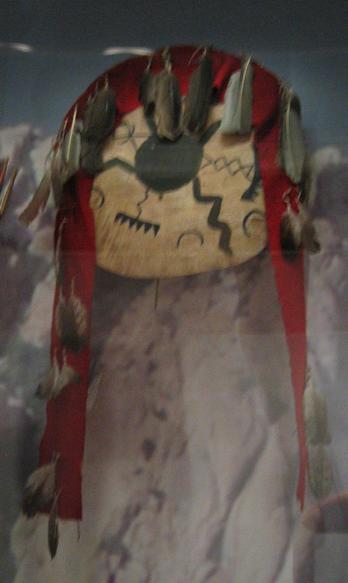
"Armor, as such, was not worn by the Chiricahua warriors, but they carried a shield of painted rawhide or cowhide with a few feathers attached."