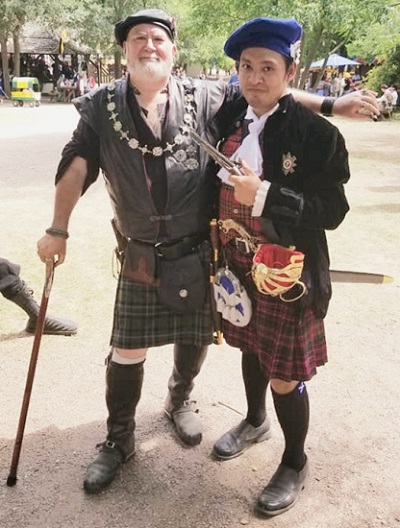
Subject: ceann-cinnidh clan chief
Culture: Scottish Highlander
Setting: Jacobite rebellions, Highland regiments, Scotland late 17th-18thc
Context (Event Photos, Primary Sources, Secondary Sources, Field Notes)
* Barthrop/Embleton 1982 p17-18
"The feudal nature and rigid structure of the Highland clan, under a chief with absolute power over life and death, allied to the warlike nature skill-at-arms and fierce pride of every member from the highest to the lowest, made it an organisation rapidly adaptable to war. When the call to arms came, the clan turned itself into a regiment: the chief became its colonel, his sons and kinsmen, who were his tenants or tacksmen, its officers, their tenants its NCOs, and their sub-tenants the rank and file. When the clan formed for battle it faced the enemy according to the social standing of its members, with the officers leading, the superior men in the front ranks, grading back to the impoverished and landless -- the common 'humblies' -- in the rear. This ranking by comparative wealth and status ensured that the better-armed and those most likely to posses powers of leadership would always be in front."
* Reid 2000 p12
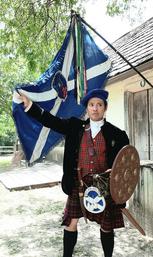
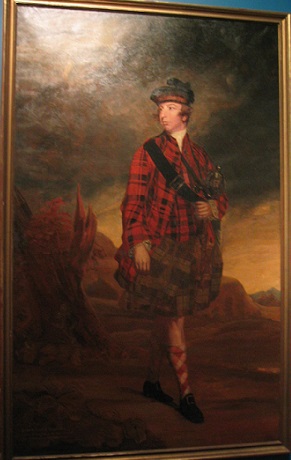
"At the head of the clan stood its ceann-cinnidh or chief, who might or might not bear a feudal title as Lord, Earl or Marquis, in addition to his name and territorial designation. Originally his single most important function was to lead his clan into battle. ...
"For the most part, the clan chiefs possessed what were regarded as the clan lands by means of a charter from the Crown. A 'piece of sheepskin' was rarely regarded as adequate title and was often required to be backed up with armed force. This was particularly the case where the lands comprised in the charter included territory occupied by members of other clans. ... This sort of behaviour was hardly conducive to good order. Sometimes a feud might result, ... but more commonly the tenants played piggy in the middle to competing demands from both masters, even as late as the 1790s.
"The chiefs possessed considerable powers, both as landlords and as the head of their 'name', which were generally exercised paternally, but were all too often characterised by outside observers as tyrannical. 'The chief generally resided among his retainers,' wrote Stewart of Garth. 'His castle was the court where rewards were distributed, and the most enviable distinctions conferred. All disputes were settled by his decision; and the prosperity or poverty of his tenants depended on his proper or improper treatment of them. These tenants followed his standard in war, attended him in his hunting excursions, supplied his table with the produce of their farms, and assembled to reap his corn, and to prepare and bring home his fuel. They looked up to him as their adviser and their protector.'"
* ScotClans online > The Clan System
"The laws and traditions of the Clan were its most sacred possession - next to its people. As the chief was inducted into his position he stood on a ceremonial stone with a sword in one hand and a white wand in the other he swore an oath to uphold these. He was the overall arbiter of Clan disputes and dispensed the law, as he dispensed the tenancy of land, Fairly and each according to his rights and needs. The Tanist as his second held the Clan lands in trust for posterity, swearing also to uphold tradition. The dispensation of the law was assisted by the 'Brieve' a form of judge who's position was hereditary and who's salary came directly from imposed fines. A council of between 12 and 14 men who met on ‘moothills’ or mounds, coming together in a circle, helped him in the undertaking. Payments to the Chief were regular and fair. 'Calpich' was a one time payment made to the Chief on the death of the head of a family. This was usually the families most prized possession, though rarely so prized as to force hardship on the family. 'Cain' was the presentation of the first fruits of the land to the Chief, land, which had most likely been given, or dispensed by that same Chief. The practice of 'Manrent' was a system of payment coming from the Septs which was offered in exchange for their continued protection. Arbitration was the most common way to settle any disputes - even between Clans. Only as a last resort and with the full support of the Clan was war considered. Nevertheless the frequency of disputes has left many a Clan with a bloody and violent history."
* Spada 2002 p151 (Paul Wagner, "Highland swordsmanship" p150-170)
"As with all Celtic societies, the Scottish Highland warriors were a highly trained and educated social elite. Combat was their primary right and responsibility, and even though the clan armies were bulked out with lower-class clansmen, most of the actual fighting was done by the front ranks of sword-armed clan elite, the 'gentlemen' or daoine uaisle ('people of pride'), and the professional warriors or ceathernach. From the age of 10 they spent the summer in 'martial academies' where they were taught how to use bows and muskets, dirks, swords and targes. Strength and agility was [sic] built in sword dances, wrestling, throwing the stone, tossing the caber and playing camanachd (shinty). The emphasis was on physical toughness, fieldcraft and individual weapon skill, rather than drill or mass manoeuvres, and the warriors so trained were proud and independent, and primarily concerned with their own individual prowess, honour and glory."
* Culloden 1996 p15-16 (Hugh Cheape, 'Preface: Highland and Jacobite culture' p12-19)
"Gaelic society honoured the warrior and consequently set store by the art of war as an aristocratic way or life. A high value was placed on hunting while those who worked the land were held in low esteem. Conventional eulogy praised the warrior, the hunter, herdsman and the steersman, but never the farmer. A lament for a MacAulay chieftain of Uig in Lewis, a celebrated hunter of deer of the seventeenth century, includes the couplet:
'Cas a shiubhal nam fuar-bheann,
Ghabh thu roghainn bha uasal ...'
'Foot that travelled the cold mountain
You made the choice that was noble ...'
"This ranking and driving force of values survived into the eighteenth century and can be seen in the military organisation of the clans during the '45. The Stewarts of Appin, strongly Jacobite in their affiliation, preserved the memory of the conventional formation of the clan regiment in battle. This formation, by ;order or nature', was strongly hierarchical and reflected the marked social standing of Gaelic society. Every regiment or clan was commanded by its chieftain as colonel, as long as he was of sufficient age. Younger brothers held next descending ranks or senior cadet branches of the family provided respectively the lieutenant colonel, the major and so on. Each company in the regiment was formed from a cadet branch of the clan or the men of a particular district and was led by two captains, two lieutenants and ensigns."
* The Jacobite Trail 2026 online
"The Jacobite risings from 1689 to 1746 were not simply a Scottish nationalist or Catholic movement — they were deeply rooted in the clan-based social structure of the Scottish Highlands. Understanding which clans supported the Jacobites, which opposed them, and why, is essential to understanding the Jacobite story.
"This guide is structured as a reference for research, education, and general interest. It covers the main Jacobite clans, the government-supporting clans, and the reasons underlying Highland Jacobite loyalty.
"[....] The reasons for Jacobite loyalty among the Highland clans were multiple and interlocking:
"Religion: Many Highland clans were Catholic or Episcopalian. The Hanoverian settlement was specifically Protestant — the Act of Settlement 1701 barred Catholics from the throne. A Stuart restoration represented the only prospect of relief for Scottish Catholics and Episcopalians from penal laws and religious discrimination.
"The Act of Union 1707: Many Highlanders resented the Union with England and saw it as a betrayal of Scottish independence. The Stuarts represented the traditional Royal House of Scotland, and their restoration offered the prospect — however vague — of a different relationship between Scotland and England.
"Traditional loyalty: The Highland clan system operated on bonds of personal loyalty. Chiefs owed loyalty to the legitimate king as part of the same framework by which clansmen owed loyalty to their chief. The deposition of James II had violated the divinely ordained order, and many Highland chiefs felt a genuine sense of obligation to the legitimate line.
"Land and title: Some chiefs had lost land or privileges in earlier risings or political settlements. A Stuart restoration offered the prospect of recovering forfeited estates.
"Resistance to Lowland Scotland: Highland society was culturally distinct from Lowland Scotland — different language (Gaelic), different law (customary Highland law), different economy (pastoral and warrior culture versus agricultural and commercial). The Hanoverian establishment represented the Lowland Presbyterian commercial class that had little understanding of or sympathy for Highland culture. The Jacobite cause offered an alternative."
* Royal Armouries Museum > War Gallery
"The highland soldier Politics, religion and clan rivalries all contributed to the decision of a minority of chiefs to support the Jacobite risings of 1689-1746. During these rebellions the fighting qualities of the Highlanders were admired by their adversaries.
"Highland society based on the feudal clan system meant that clansmen could be called upon to fight at the whim of their clan chief. The British army recognised the qualities of the Highlanders and in 1739 Highland companies were raised. These were soon expanded into several regiments. After the 1745 rebellion it was considered advisable for these regiments to serve overseas. Their skills were put to good use in the often irregular style of warfare encountered in the Americas.
"By the late 18th century, Highland regiments were regarded as identical to other British line regiments in all respects except dress, tradition, and military prowess."
Costume
* Cannan 2009 p85
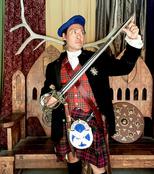
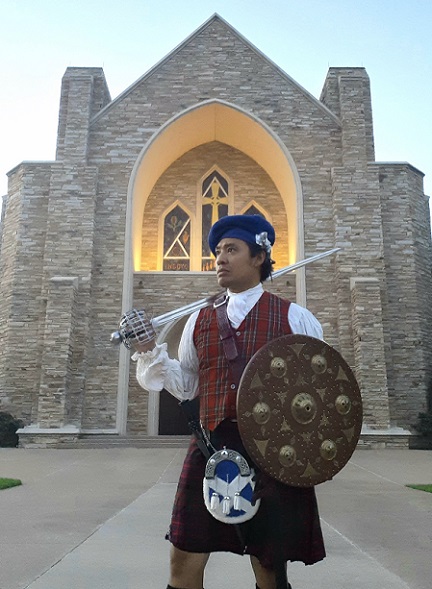
"In the sixteenth century Highlanders are generally described as bare-headed, but in the early years of the next century they evidently took a fancy to the Lowlandman's bonnet and began wearing, quoting again from Defoe, 'a cap on their heads, called by them a bonnet'. A representative summary of Highland dress in its complete form is given by the eccentric John Taylor (c. 1578-1653), a Thames waterman and poet, in his account of a journey to Scotland:
Their habite is schooes with but one sole apiece; stockings (which they call short hose) made of warm stuffe of diverse colours, which they call Tartane: as for breeches, many of them, nor their forefathers, never wore any, but a jerkin of the same stuffe that their hose is of, their garters being bands or wreathes of hay or straw, with a plead about their shoulders, which is a mantle of diverse colours, much finer and ligher than their hose, with blue flat caps on their heads, a handkerchief knit with two knots about their necke; and thus they are attyred ... As for their attire any man of what degree soever that comes amongst them, must not distaine to weare it.
Magnificent in the great kilt, the fèileadh-mòr and plaid ('blanket'), or in tight truibhs ('trews'), and customarily a short jacket cut from breacan (tartan, from the word for 'speckled'), in the early years of the 1600s the Highlanders blossomed into the tartan-clad heroes that are today so celebrated. It is important to note here that clan tartans did not exist. That said, we can detect the beginnings of clan and district colours."
* Young/Miller 2017 p14
"Before the Battle of Culloden, plaid was seen as barbaric and licentious by those outside the Highlands, and it was often insinuated that tartan allowed the Highlanders to disguise themselves in the heather to rob and steal. The Revd Thomas Morer in 1692 said 'lowlanders say, being thieves, these plaids cover stolen booty', while Burt wrote that tartan encouraged 'an idle life in lying upon the heath' and that it 'serves to cover them in the night when they lie in wait among the mountains, to commit their robberies and depredations; and is composed of such colours as altogether, in the mass, so nearly resemble the heath on which they lie'."
* Dunbar 1977 p33
"The kilt as we know it today almost certainly originated early in the eighteenth century. The word 'kilt' was not used by the Gaelic-speaking Highlander: he described it as the Feileadh Beag, which meant the 'little wrap', to distinguish it from the Feileadh Mor, the 'big wrap'. The former was often Anglicised as 'philabeg'."
* Young/Miller 2017 p32
"By the seventeenth century fashions favoured fuller clothing with extensive layers that indicated wealth and status. Tartan fabric was gathered around the waist and belted, and known in Gaelic as the fèileadh-mòr (great wrap) or breccan-an-fèileadh (tartan wrap). The fèileadh-mòr was placed on the ground in pleats, and the wearer would wrap the edges of the fabric around his stomach and secure it using a heavy leather belt. Once standing he would typically drape the excess material around one shoulder and fasten with a pin."
* Barthrop/Embleton 1982 p29-30
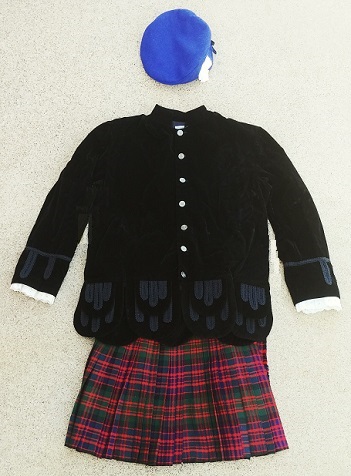
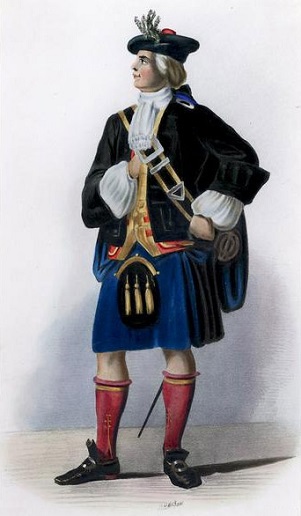
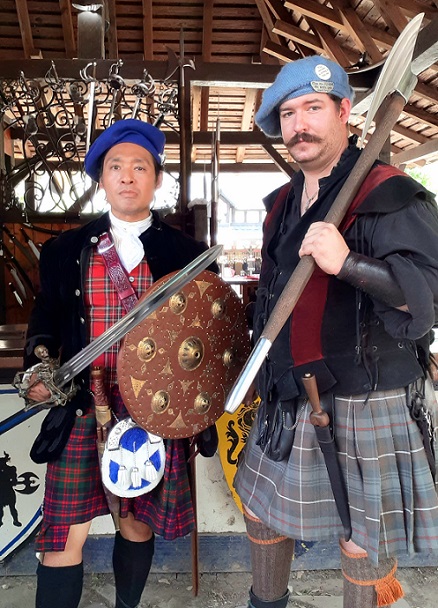
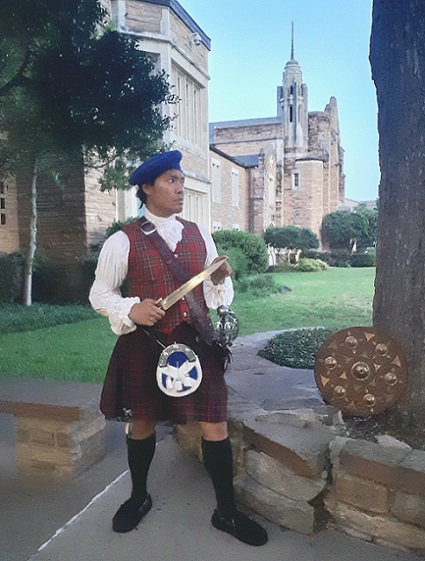
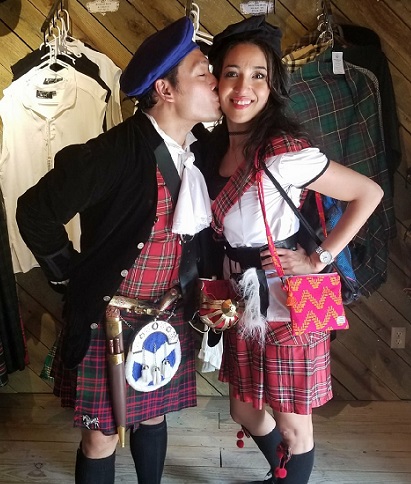
"During the 50-odd years of the Rebellions the basic dress of the Highlander was the belted plaid, a rectangle of tartan cloth about six yards by two, which was belted round the waist so that the lower portion hung to the knees as a roughly pleated skirt, leaving the mass of material either to be wrapped round the upper part of the body, or draped up and fastened near the left shoulder to leave the arms free. To this, according to his means, the Highlander would add a woollen bonnet, a shirt, waistcoat, jacket or short coat, hose and shoes. A feature of Highland upper garments in the 17th and early 18th centuries was the slashing of sleeves and breasts of the coat. Alternatively, and sometimes additionally, he might wear close-fitting trousers, or trews, a garb more usually favoured by the upper classes out of doors, since it was more convenient for riding. From around 1725 some Highlanders began to wear the 'little kilt', which was simply the plaid with the upper and more voluminous portion cut off. This was the forerunner of the modern kilt, though it must be remembered that Highland dress was banned for nearly 40 years after the '45, except in Highland regiments, and did not regain its popularity until after 1822, by which time it was very different from that worn before proscription.
"... [I]t is enough to say that the notion of a particular clan being distinguished by its own sett did not apply during the Rebellions. Members of a clan recognised each other by the badge in their bonnets. In the 18th century the only uniformity of setts was to be found in the Government's Highland regiments, and the clan tartans of today originate from no earlier than the 19th century, as indeed do such items as large and highly decorative sporrans or purses, ornate plaid brooches and 'sgian dubhs' stuck in the hose-tops. The earlier Highlander's purse was a small leather pouch suspended from his waistbelt, while he fastened up his plaid either with a bodkin or a loop and button."
* Calasibetta/Tortora 2003 p267
"Highland dress Traditional man's costume of Scots Highlander, consisting of kilt; plaid over one shoulder fastened by brooch; scarlet jacket; wide belt with sporran attached; feather bonnet or glengarry cap; plaid-top socks; and buttoned gaiters over shoes. Costume was forbidden by law from 1747-1782."
Pistol
* Treasures from the Tower of London 1982 p77
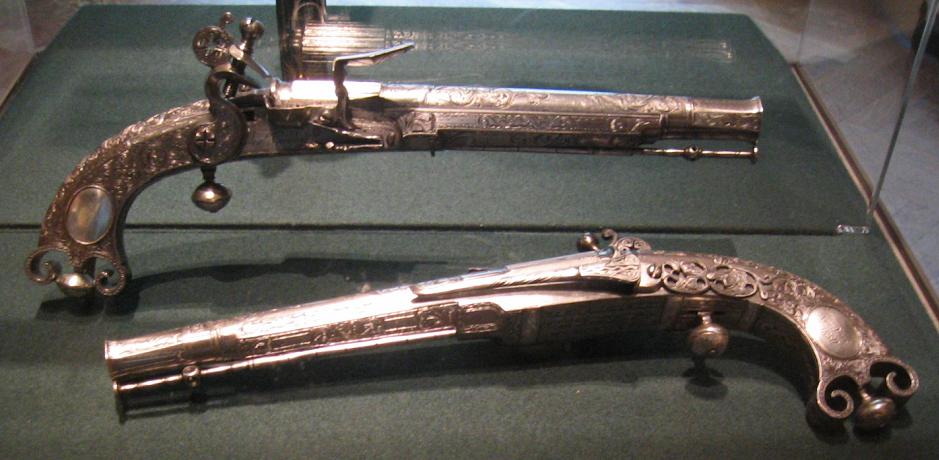
"By the end of the sixteenth century a recognisably Scottish styles of firearm had appeared. For many years it was generally accepted that this style derived, like that of contemporary English guns, from Continental, and probably Dutch prototypes. However, it now seems far more likely that the Scottish and English styles, which display very close similarities, evolved as a result of an interchange between the two nations, probably with the English influencing the Scottish style rather more than the reverse. The decoration of Scottish firearms is one of their more distinctive characteristics, the metalwork often being engraved, with a mixture of Romanesque scrollwork and Celtic patterns."
* Metropolitan Museum of Art 1971 p51
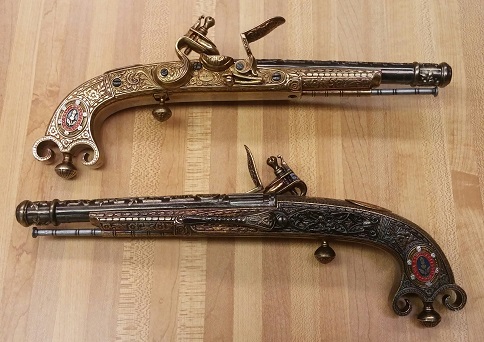
"Among the characteristic features that distinguish Scottish pistols from all others are: steel or brass stocks, the style of butt, the picker (used to clear the lock of powder fouling) that fits into the butt, globular triggers, the lack of a trigger guard, and the profuse ornamentation of scrolls and Celtic strapwork, often inlaid with silver. Furthermore, they were made in pairs, the 17th-century ones with right- and left-hand locks. There are four principal types of Scottish pistol, distinguished by their butts: the fishtail, heart-shaped, lobe-shaped, and scroll or ram's horn. The lock mechanisms used are the snaphance (dated examples range from 1598 to 1686) and the flintlock."
* Arms and armor 2002 p25
"The Highland warriors of Scotland carried distinctive arms of novel design. Their pistols, unlike those made elsewhere in Britain, were constructed entirely of metal, either steel or brass, and were engraved and often silver-inlaid with geometric and foliate ornament of Celtic inspiration."
* Wilkinson-Latham 1977 p36
"Scottish pistols were distinctive in design. The early versions had conventional wood stocks with snaphaunce locks but later the stocks were made of metal, usually steel but sometimes brass. These metal stocks were engraved and often inlaid with silver. A main feature, as with the long arms, was the absence of a trigger guard and a ball or button trigger. The pistols were usually carried in pairs and most surviving examples are fitted with a belt hook or clip. The all metal pistol continued in use in Highland dress and in Highland military dress long after it had ceased to be regarded as an effective weapon. Dress pistols continued to be made well into the nineteenth century.
"The all metal stock it seems was useful also as a club. In 1596 an inhabitant of Edinburgh was set upon by a band of robbers and they were reported to have 'dang him with pistolets on the heid ...'"
* Ricketts 1964 p51-52
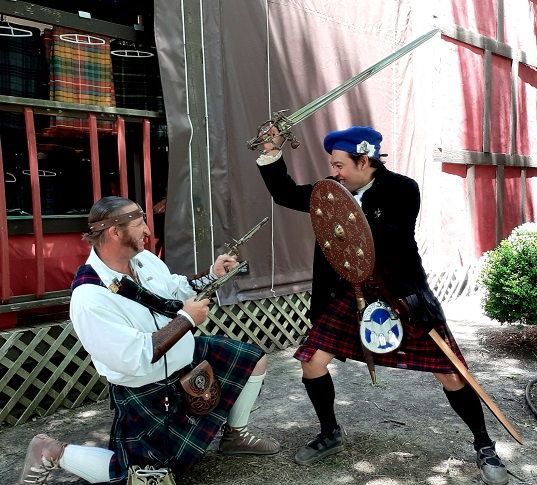
"One can date these [Highland all-metal pistols] by the shape of the butt. The fishtail butted pistol survived until the middle of the seventeenth century, when it was followed c. 1640 by a lobed butt which in turn was succeeded by the heart-shaped butt. These were all produced until the middle of the eighteenth century. But around 1700 the 'ram's horn' butt came into fashion which is perhaps the best known of them all. The steel stock had an important function during battle. The form was for the Highland soldier to cover himself with his targe or small circular shield, run towards the enemy, discharge his musket and then drop it. After a few yards and at a distance of about ten yards from the enemy lines he fired and threw his pistol at his adversary; after that , providing he had not been hit, he attacked in close combat with broadsword and dirk. It is unlikely that officers, who highly prized their privately-owned pistols, followed this procedure."
*Capwell 2007 p86
"The typical features of Scottish pistols were an all-metal construction (usually steel), matching trigger and pricker, and very elaborately engraved and inlaid silver decoration, often involving flowers and scroll-work. They never had trigger guards.
"The but of a Scottish pistol, from the mid-seventeenth century onwards, was generally given a characteristic 'ramshorn' or 'scroll' form. The pistols were made to be slipped into the owner's belt, and were generally fitted with long belt hooks to keep them in place."
* Fryer 1969 p8
"Highland Pistol A Scottish all-metal pistol with distinctive ramshorn scrolled butt. A pricker with ball terminal was usually fitted between the scrolls. The stock was generally of steel, frequently inlaid with silver scrollwork, and engraved. It had a ball trigger and was fitted with a belt hook. Later 'dress' pistols with flintlock or percussion locks were also made with ramshorn butts."
* Bull 1991 p115 caption
"By the eighteenth century many Scottish pistols were entirely metal and equipped with a heart-shaped butt and a belt-hook. Highlanders seldom used holsters, preferring to attach the pistol to a belt or tuck it into clothing. Until 1795 highland regiments carried the native pistols. Not everyone was impressed with them, however, as in 1846 the authors of The Costume of the Clans described them as 'coarse pop-guns, resembling more the tin toys of the bazaar than the weapons of an army'."
* Wilkinson 1974 p38
"By the end of the 17th century or the early 18th century, the all-metal stock, for by now they were almost invariably completely of metal, was fitted with a heart- or kidney-shaped butt.
"Another feature which remained with these pistols right up until their disappearance was the omission of a trigger guard and the use of a small ball trigger similar to that found on some of the early 17th-century pocket pistols. During the second half of the 18th century the heart-shaped pommel was replaced by the so-called ramshorn type which terminated in two inward-curving scrolls. Situated between the two arms was a small ball which could be unscrewed and was the base of a metal needle used to clear the touch hole. The metal stock was frequently engraved with elaborate Celtic scrollwork. Basically the mechanism was the standard flintlock."
* Pittock 2016 p42
"Pistols were usually made of imported iron, and could carry Celtic designs. Many Jacobite pistols were made in Scotland, by gunsmiths such as McNab of Dalmally and Caddell of Doune; these were all-metal guns, often with a ramshorn butt. Star and rose decorations, symbols of the Stuart cause and its heirs, were common. Barrels were arround 25-36 centimetres (short 16-centimetre barrels are known in the heart butt pattern), bores 12-16 millimetres. The Doune pattern pistol, widely used by officers and cavalry, had a ramshorn butt and 25-centimetre barrel. Cheap pistols might cost less than £1 sterling the pair, but ornate ones were of course very much more expensive. Pistols usually weight about 1.25 kilograms. Although Doune was the centre of the trade, a wide range of pistols were made in Edzell, Brechin, and Leith, most with bores of around 13-14 millimetres, with some ranging as high as 19. Buchanan of Glasgow's pistols had 28-centimetre barrels and were of 12.7-millimetre bore. Heart-butted rather than scroll-butted pistols were more usual on the east coast."
* Reid/McBride 1997 p32
"Highland, or rather Scottish, firearms were distinctive in form. Most notable were the all-metal pistols, made chiefly at Doune, which had cast steel (or less commonly brass) stocks in place of the conventional wooden ones. This permitted a considerable variety of styles and decoration, particularly engraving and inlay."
* Byrd 1996 p55
"The word 'dag' refers to the shape of the pistol's butt. These pistols were stocked with brass or iron stocks. They had tapering barrels of large caliber (.58-.69). They had no sights. They were flintlocks and had a belt hook on the left side. There was no trigger guard. It had a round ball styled trigger and a thin metal ramrod.
"Being a 'Highland' item it was manufactured in the Lowlands. The Armory at Doune made thousands for highland military units.
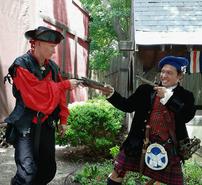
"In battle these were used after the first volley was fired from the Brown Bess musket. The pistols were drawn and held at the ready for the charge of infantry or cavalry. The massive wave of lead from these pistols disrupted the charge. The Highlanders followed with a charge using broad sword and dirk."
* Cannan 2009 p87
"[A] well-armed Highlander would carry a brace of pistols. Highlanders often had better guns -- nearly always snaphances -- than those issued to the average soldier of the day, even if a degree of retention of obsolete firearms is hinted at by Taylor's reference to not only muskets but also arquebuses, while the Perthshire survey lists two 'hagbutts'.
Sword
* Culloden 1996 p22 (AVB Norman, 'Scottish swords and the '45' p22-53)
It is not at all clear when the basket-hilted sword was introduced to the Highlands: apparently no representation occurs on the carved stones of the area. However, the use of the phrase 'Irish hilt' for a basket hilt was fairly widespread in English documents from about 1620, 'Irish' in this case meaning Gaelic. This presumably indicates that by this time the basket hilt was regarded as characteristic of the Scottish Highlands."
* Wallace 1970 p22-23
"So far, there are no paintings known which show a Scot wearing a broadsword earlier than the portrait of an Unknown Highland Chieftain, in the Scottish National Portrait Gallery, and about 1670 in date. Examination and comparison ... will show a fairly clear sequence of the basket-hilt's development in Scotland; but without dateable portraits for comparison purposes, it is difficult to assign a particular seventeenth century broadsword to a particular decade.
"Once into the eighteenth century, it is easier to date a basket-hilt sword, not only because of existing eighteenth century portraits which feature such swords, but because we are then within the period of known guard makers who signed their work, making it easier to establish a reasonably accurate dating structure. There were, of course, sword makers in Scotland long before John Simpson of Glasgow. Four trades seem to have participated in the production of swords. Armourers, Gairdmakers, Cutlers and Lorimers. A Statute of 1548 refers to cutlers making 'byknyves, quhingaris, dudgeons, sowrds, grithand sourds with hilt and plummet', and to lorimers making 'gairds'. Obviously, swordsmithing was not confined to the major towns like Glasgow, Edinburgh, Perth and Inverness: many of the cruder guards of the seventeenth and early eighteenth centuries must have been made north of the Highland Line, where families and known to have held their land by their position as hereditary armourers to a chief."
* Reid/Zaboly 2006 p47-48
"Most of the clansmen depicted in an important series of eyewitness sketches by an unknown artist from Penicuick, near Edinburgh, are indeed carrying or brandishing the swords with which they are still popularly associated, and it is true that contemporary commentators on both sides wrote as if all or most had them. On the other hand, closer investigation reveals a rather different picture. Returns of weapons seized or surrendered in the months after Culloden actually included comparatively few broadswords. [....]
"[....] There is, of course, a lively possibility that some men had chosen to conceal their swords; but this cannot cancel out the evidence from Culloden Moor itself. The generally accepted estimate is that up to 1,500 Jacobites may have been killed or wounded there, and at least 750 were certainly counted lying dead on the battlefield; yet when it was cleared, only 190 broadswords were recovered. This must mean that at best only one in four of those killed or wounded on the moor itself was carrying a broadsword at the time. This would have been sufficient for each of those standing in the front rank -- the Highland gentlemen; but their followers in consequence must have been relying upon their firelocks and bayonets."
* Cannan 2009 p86
"Swathed in tartan, the Highlander would festoon himself with as many weapons as he could possibly carry. Highland swords were no longer like those of their medieval forebears. In the mid sixteenth century, basket-hilted swords had begun to be used in Scotland. Its roots lay in continental Europe, but from the seventeenth century it became a decidedly Highland weapon, with a huge blade of positively 'halflang' dimensions, either 'broad' (double-edged) or 'backed' (sharp on one side only) -- often 'extravagantly and I think insignificantly broad' in Defoe's opinion. This was the true claymore, and the word itself was a Highland battle-cry."
* Capwell 2007 p82
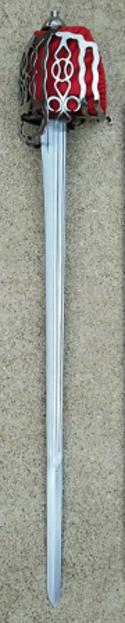
"Perhaps the most famous of all Scottish arms is the basket-hilted sword or 'claymore'. This broad-bladed weapon, with a cage-like guard to protect the user's hand, was the preferred weapon of the Highland warrior throughout the 1600s and until the mid-1700s. Claymores were sometimes called 'Irish' hilts because the Gaelic-speaking Highlanders were often referred to as the 'wild Irish' by the English and Lowlanders. Highlanders had a formidable reputation. Writing in the early 1700s, the historian John Campbell wrote that they carried 'a broad sword, which they call a claymore, a stroke of which, delivered from one of their hands, would be sufficient to chop off the head of the strongest champion that ever lived...' .
"Although the vast majority of Scottish basket-hilted swords were used by Highlanders, most if not all were made in the Lowlands. Arms workshops were based in trading communities bordering the Highlands, such as Glasgow and Stirling. The blades were almost always imported from Germany -- Scotland never had a significant blade-making community, and high-quality blades were easy to buy in from abroad. The fairly standard imported blades were bought by Scottish swordmakers who then mounted them with distinctive and often exquisitely-crafted hilts.
"Many of these German blades are inscribed 'Andrea Ferrara', the name of a semi-mythical Italian bladesmith who supposedly lived in the sixteenth century. In Scotland this legendary name became a byword for quality. Occasionally German smiths would put other messages or inscriptions on their blades to make them more attractive to Scottish buyers. One sword in Glasgow's collection bears the words 'Gott bewahr die oprecte Schotten' -- 'God protect the upright Scots'.
* Wilkinson 1971 p130-131
"[F]or the last 200 years the term [claymore] has been applied to the basket-hilted broadsword. The basket-hilt probably had its beginnings in Germany and, apart from bars, often incorporated solid plates. By the seventeenth century, this full basket-hilt was in use in Scotland and has continued to be favored there until the present. The inside of the basket is fitted with a layer of leather. Blades are straight and double-edged and, in the past, often bore the name of Andrea Farrara, blade-maker, whose name was a guarantee of quality, pirated for years after his death."
* Reid 2000 p27-28
"The pre-eminent Highland sword remained the claymore in its ultimate form as the basket-hilted broadsword. Appearing in the mid-16th century, it did not supplant the two-handed sword but was simply a logical development of the quilloned weapon which appeared in the early Middle Ages. Normally the blade was double-edged, but single-edged backswords became quite common in the 18th century, as did a couple of quite bizarre variants. One was the Turcael or curved Turkish blade. Few survive, apart from those carried in the 19th century by the Light Company officers of Highland regiments, but a good example can be seen in Wait's portrait of Alasdair Mor Grant, the Laird of Grant's champion, and a surprisingly high proportion of the clansmen drawn by the Penicuik artist in 1745 carry curved blades. Another, less common variant, also illustrated in the same sketches, featured a straight blade with serrated edges, like some 16th century rapiers and Landsknecht swords." [NOTE: See also Reid & McBride 1997 p53]
* Metropolitan Museum of Art > Stone Gallery of Arms and Armor
"Basket-Hilted Broadswords Early forms of basket-hilted broadswords were known in England and Scotland during the sixteenth century. In the beginning of the seventeenth century, a distinctive type of basket hilt became the characteristic hilt of the Scottish Highlands, where it remained an integral part of Highland dress until the mid-eighteenth century. The Highland hilt was fashionable in England throughout this period. Various forms of basket-hilted swords were also carried by British colonists in North America."
* Barthrop/Embleton 1982 p18
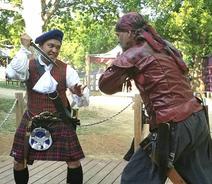
"[D]uring the 17th century they [claymores] were generally superseded by the basket-hilted broadsword, the blades of many being cut down from old claymores. The basket hilt originated on the Continent, whence it was adopted in England during the Civil War for use by cavalry, and indeed continued as the cavalryman's sword until well into the 18th century. Whether the Scots took it up through contact with Cromwellian horse, or acquired it straight from the Continent, seems uncertain. In any event, it had become the Highlander's prime weapon by the late 17th century. He confronted his foe with broadsword in right hand, dirk in his left, and targe on his left forearm. In the '45 a much greater proportion of clansmen than before had muskets, the best of which were of French or Spanish manufacture, the native variety often being old and unserviceable. Even so, due to the overall shortage of ammunition, each man on average having only 12 rounds, the clansman still relied on the sword, rather than musketry, to overcome his enemies."
* Reid/McBride 1997 p52
"Notwithstanding the widespread use of firearms during the '45, Highlanders are traditionally associated with edged weapons and, in particular, the basket-hilted broadsword, commonly (and accurately) referred to as the claidheamh mor or claymore. In practice, the use of swords was probably quite limited, confined largely to the 'gentlemen' who formed the front rank of a Clan regiment. Although literary sources dwell on the more romantic weapons such as blued steel blades, often bearing the entirely spurious signature of Andrea Ferrara (most blades appear to have been German in origin), more prosaic records and some contemporary illustrations reveal that the ordinary Clansmen standing behind them normally had bows, spears or axes, and later firelocks and bayonets."
* Fryer 1969 p67
"Scottish Broadsword The distinctive basket-hilted sword with broad double-edged blade, carried by the Scots since the seventeenth century. The type survives in the regulation pattern of the Highland regiments. Designs of hearts and S motifs are frequently used on the hilts."
* Boeheim 1890 p264
"Der Umstand, daß um diese Zeit die schottischen Reiter mit einer der schiavona ähnlichen Waffe ausgerüstet wurden, welche sie, nebenher bemerkt, noch gegenwärtig tragen, hat zu einer Verwechselung des claymore mit der schiavona Veranlassung gegeben. Die schiavona der Schotten besitzt einen schweren, durchbrochenen Korb aus Blech, der innen mit leder ausgefüttert ist."
* Cannan 2009 p95
"The basket-hilt -- 'a broad Sword which they call a Clymore', writes John Campbell in his Description of the Highlanders (1752) -- continued to be the main weapon of well-to-do Highlanders. A single 'Stroke' of the claymore, Campbell adds, 'delivered from one of their Hands, would be sufficient to chop off the Head of the strongest Champion that ever lived.' Despite the Victorian stereotype of the Jacobite Highlander being a man armed with a broadsword and targe, it is striking that whereas Cumberland's redcoats collected 2,320 firelocks from the battlefield at Culloden, they found only 190 swords."
* Treasures from the Tower of London 1982 p53
"The basket-hilted broadsword, known since the seventeenth century as the claymore ('great sword' in Gaelic), is the characteristic weapon of the Highlanders of Scotland, and is still carried by the officers of the Scottish Line Regiments on ceremonial occasions."
Shield
* Reid 2000 p28
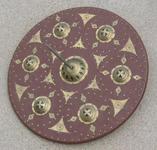
"With the sword went the targe, a round shield usually made of plywood and covered with leather. The most detailed description of one is provided in a letter written by Henry Fletcher in 1719, although it is unlikely that all were so elaborately constructed: 'The outward form of ane Highland targe is a convex circle, about 2 foot in diameter, but some have them oval; the innermost part of it nixt the man's breast is a skin with the hair upon it, which is only a cover to a stell plate, which is not very thick, for the whole is no great weight; on the inner side of this Steel plate the Handle is fixed, which hath two parts, one that the left arm passes throw til near the elbow, the other that the Hand lays on: without the Steel plate there is a cork which covers the Steel plate exactly, but betwixt the Cork and the Steel plate there is Wooll stufffed in very hard: the Cork is covered with plain well-wroght leather, which is nailed to the cork with nails that have brass heads, in order round, drawing thicker towards the centre. From the centre sticks out a Stiletto (I know not the right name of it, but I call it so, because it is a sort of short poignard) which fixes into the steel plate and wounds the Enemy when they close: about this Stiletto closs to the Targe there is a peece of Brass in the form of a Cupelo about 3 inches over and coming halfway out on the stiletto and is fixed upon it. Within the brass there is a peece of Horn of the same forme like a cup, out of which they drink their usquebaugh, but it being pierced in the under part by the Stiletto, when they take it off to use it as a cup, they are obliged to apply the forepart of the end of their finger to the hole to stop it, so that they might drink out of their cup.'" [sic...]
* Rector 2001 p8 (Paul Wagner, 'Gaelic swordshamship' p6-16)
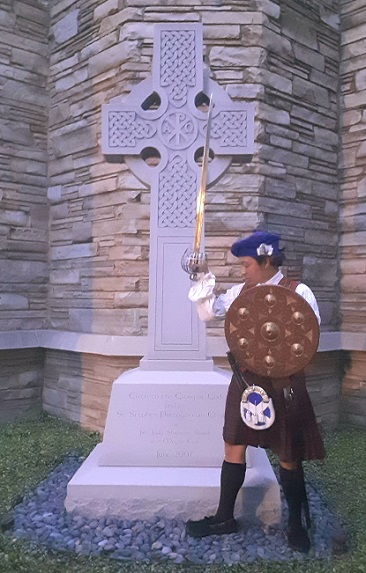
"One of the most distinctive Highalnd armaments was the combination of 'a very broad sword' and 'a strong handsome target,' which became the standard Highland weaponry during the Jacobite era. While 'bucklairs' were widely used in the Highlands until at least the mid-16th century, the target or 'targe' had also been in use since at least the 14th century, and became the standard Highland shield. The Highland targe was a stout round shield constructed of dense, strong wood, either oak or Scots pine, with two layers of 1/4 inch planks glued together at right angles, forming a strong cross-ply. The front was covered with tough cow-hide and further strengthened with brass studs and metal plates on the front and sides. The back was covered with cow, goat or deer skin, and stuffed to absorb blows, and fitted with an arm loop and iron or leather hand grip, allowing a dirk to be held in the left hand and wielded offensively. Some targes also had a 10 inch spike that could be screwed into the central boss. Surviving targes are generally in the 18-21" range, and were thus a unique form of shield, significantly smaller than the large round targets described by Renaissance fencing masters like di Grassi and Marozzo, but somewhat larger than the small bucklers used in medieval manuals such as Tower Manuscript I.33."
* Culloden 1996 p55 (Jackie Moran, 'Highland targes' p55-59)
"The word 'targe' has no real meaning for us until the 17th century, when it signifies the shield carried by the Highland fighting man. Targes are circular, around 20" in diameter and are normally very strongly constructed of oak or pine, or a combination of both. Two layers of wood are laid across each other for strength and covered with cow hide. The surface of the leather has designs tooled on it in panels of varying shapes which may be outlined and emphasised by brass- or silver-headed studs of different sizes. There is almost always a central boss of brass which may be pierced to take a spike. On some targes the boss is lined with cow-horn and forms a drinking cup."
* Fryer 1969 p80
"Targe The Scottish circular shield. It was of wood covered with leather and studded with patterns of brass nails and bosses."
* Wilkinson 1971 p131
"Scottish shields were round and made of wood-covered leather reinforced with brass-headed nails."
* Cannan 2009 p95
"[The] targe [was] ... an item, Campbell avers, 'so strong that no Ball can penetrate it'. In its design the targe had not changed substantially since the days of Montrose, though fewer of them were now used. Lord George Murray, a veteran of the 1715, 1719 and 1745 rebellions, probably owed his life to a targe, which was nicked with two or three bullets during a skirmish in 1745 with dragoons near the village of Clifton, close to Penrith."
* Arms and armor 2002 p24
"In his Description of the Highlands published in 1752, John Campbell observed in detail the distinctive appearance and armament of the Scottish warrior, including his plaid coat and kilt and his abundant weaponry, the latter comprising a broadsword, a pair of pistols, and a dirk: 'And to finish the Dress, they wear a Target, composed of Leather, Wood and Brass, and which is so strong, that no Ball can penetrate it, and in the Middle of his Target there is a Screw Hole, wherein is fix'd a brass cap lined within with Horn, which serves them to drink out of upon Occasion; and in Time of Action it serves for to fix a Bayonet in. Thus accoutered they make a most splendid and glorious Appearance, it being esteemed by all Judges to be the most heroic and majestic Habit ever wore by any Nation.'"
*Capwell 2007 p83
"When fighting with a claymore, a Highlander nearly always carried a targe. This round shield became just as iconic as its razor-sharp partner. Targes were made of two layers of oak boards, the grain of the first placed at 90 degrees to that of the second in order to make the targe stronger and more difficult to split. Then for additional durability, targes were covered in leather and backed with deerskin.
"Finally, many targes were elaborately decorated. Intricate designs were tooled into the leather and brass studs fixed into it to create even more complex patterns. On the finest targes flat or rounded plates of brass were also used, creating impressive and highly individualized works of art."
* Stone 1934 p605
"TARGET, TARGE. A round shield with loops on the back through one of which the arm was passed while the other was grasped by the hand. This name as applied to a shield goes back to 12th century and was used, especially by the Scotch, as last as the early 19th. Targets vary considerably in size but most are about two feet in diameter, through some of the early ones were much larger. In the 16th century some were oval.
"The typical Scotch target was about twenty inches in diameter, and was made of wood covered with leather studded with brass bosses. It had a central spike which was sometimes as much as ten inches long and could be unscrewed and carried in a pocket in the deerskin lining. It usually had two handles, but sometimes three, or a long leather sleeve covering the entire forearm, and having a handle at the end." [reference omitted]
* Spada 2002 p161 (Paul Wagner, "Highland swordsmanship" p150-170)
"The Highland 'targe' was a stout round shield of which the earliest surviving examples are from the 16th century, but are referred to in an Act of the Scottish Parliament in 1456. They typical Highland targe was constructed of dense, strong wood, either oak or Scots pine, with two layers of 1/4 inch planks glued together at right-angles, forming a strong cross-ply. The front was covered with tough cow-hide and further strengthened with brass studs and metal plates on the front and sides, and the back was covered with cow, goat or deer skin, and stuffed to absorb blows. Some targes also had a 10 inch spike that could be screwed into the central boss.
"The 17th and 18th century Highland targes were a unique form of shield. Most were only 18-21 inches in diameter, and thus significantly smaller than the large round targets described by Renaissance masters like di Grassi and Agrippa. However, they were also somewhat larger than the small buckler's use in I.33, and instead of being held with a 'punch-grip', they were fitted with an arm loop and iron or leather hand grip, giving a sturdier hold against the impact of a thrusting pike, bayonet or heavy musket-butt, and also allowing a dirk to be held in the left hand and wielded offensively."
* McBane ed. Kirby 2017 p92-94 (writing in 1728)
"The Target being much broader [than the Buckler], is fixed from the Wrist to the Elbow, in order to Cover the Left-side, and was much used formerly as a Defence against Cut, Thurst, Shoat Halbert and Pike, Lochaber-ax, or Horse Man.
"This Target is of great use to those who rightly understand it, but to unexperienced People is often very Fatal, by blinding themselves with it, for want of rightly understanding it. Therefore who has a mind to use it must take care to have it upon an Edge, so as to Cover his Left-side from which is a Defence against Ball or any Weapon."
* Reid/Zaboly 2006 p48
"There may ... have been a similar shortage of the round shields called targes. The named highland gentlemen in the [Penicuick] sketches generally carry them, but not the rank and file."
Dagger
* Wilkinson 1971 p131
"The Scots also carried a large dagger which became known as a dirk, although in the seventeenth century the term was used for some other weapon. The dirk probably developed from the older ballock dagger. Hilts were simple, with a flat top pommel and two lobes at the base where the blade joined the grip. The wood was often carved with typical Celtic, interwoven strap decoration. Blades were usually straight, tapering to a point; many early examples utilized cut-down sword blades."
* Wallace 1970 p58-59
"The dirk in its early form had inherent weaknesses. At certain points it was particularly vulnerable to strain .... The fully developed weapon is mounted with metal. The lower end of the hilt is fitted with a metal guard plate where it joins the blade. Frequently, metal straps go up the edges of the haunches. The flat pommel plate is now expanded to fold over the pommel edges, and becomes a pommel cap. The entire surface of the grip and haunches is boldly carved with multi-ply interlace and triquetras. Often raised studs are carved in the interspaces. The haunches are no longer well-rounded in the ballock-knife sense, but have their sides flattened in the same plane as the blade. Yet some of the older characteristics remain. The pommel continues to be relatively large. The guard plate still shows a pronounced incurve.
"By this time, cut-down sword blades were being used extensively. Either the dirkmakers were practising thrift or themselves acknowledged that their home-manufactured blades could rarely equal in temper the blades forged in Solingen and Passau. The scabbards now have metal lockets, with lips curved to fit the shaped guard mount of the weapon. The pockets for knife and fork are metal bound. The practice of carrying the knife and fork one below the other begins, though the knife and fork side by side is still in evidence as late as 1748 to be revived again in the nineteenth century. The weapon was suspended by a leather loop, often on a metal ring fixed at the back below the metal locket."
* Neumann 1973 p230
"Full Development, Circa 1700-1750 The dirk achieved what is considered its purest form in this era as it acquired a metal pommel cap (usually silver, brass, iron, or pewter), plus metal bands around the base and often on the flattened sides of the lobes. The grip, itself, was generally carved with intricate interlaced Celtic patterns. The long single-edged blade (12-17 inches) persisted."
* Wilkinson-Latham 1973 p47
"The dirk was an integral part of the highland dress carried by civilians and clan members in the style of European gentlemen of the early 17th century. Early types of dirks had their blades made from broken sword blades but, by the 18th century, a typical blade shape had been adopted with a single cutting edge, a flat back tapering to an edge on the bottom few inches. One cannot be dogmatic about this blade form as double edged dirks and dirks even with triangular or diamond sectioned blades are known and documented."
* Pittock 2016 p43
"The dirk (some of which were made from converted claymores, either broken or no longer fit for use), was a long stabbing knife or short sword with a 45-centimetre blade, often a shortened sword blade, known from at least the sixteenth century. Dirks were customarily held in the left or targe hand, to stab an adversary at close quarters once the targe had deflected the bayonet.'
* Stone 1934 p209
"DIRK. A dagger, especially that carried by the Scotch Highlanders. The Scotch dirk has a very heavy blade, thick at the back, single-edged and tapering uniformly from hilt to point. It has a barrel-shaped grip with a conical, flat-topped pommel, and no guard. The hilts are generally decorated with strap work." [references omitted]
* Calizzano 1989 p18
"[L]es Highlanders ... avait pour habitude de porter un couteau, le Dirk, comprenant une gaine agrémentée de deux accessoires: un couteau et une fourchette. Il se composait d'une lame droite, à un tranchant ou un tranchant un tiers, montée sur une poignée en bois, cuir ou ivoire. La forme de cette poignée est caractéristique et particulière: en diamètre supérieur, se rattache à la deuxième suivant une ligne ogivale. Celli-ci se rétrécit vers le pommeau selon un profil en amphore dont le col soutient la troisième section constituant le pommeau de diamètre égal, ou presque, à la premère section.
"Certains auteurs ont voulu voir dans la forme ainsi décrite un symbole phallique vraisemblanblement lié à des vestiges de cultes ou de croyances celtiques. La poignée, ornée de motifes entrelacés, témoigne également de l'influence de cette culture. Le pommeau at la virole du manche sont en métal (laiton ou argent) et le fourreau comporte, sur sa face intérieure, deux logements superposés destinés à recevoir un couteau de dimensions réduites et une petite fourchette. Ces deux accessoires sont fabriqués <<en suite>> avec le plus gran couteau. Des pièces extrêmement riches, ornées d'or, d'argent e de pierres semi précieuses, aux lames finement gravées datent à peu près de la fin du XVIIIe siècle et du début du XIXe siècle."
* Culloden 1996 p94
"Dirk A Scottish dagger, a late form of the ballock knife (Gaelic, biodag)."
* Peterson/Feaser 1966 p40-41
"This sturdy weapon developed during the seventeenth century as an offshoot of a general European knife called a kidney dagger because of the shape of its hilt. Like the earlier scramasax, the Scottish dirk had no guard, and indeed, the dirk resembled the ancient Viking knife in many features of its design and in the place of importance it held. It became so much a symbol of Scottish nationalism that the English temporarily banned the dirk after the rebellions of the early eighteenth century. Soldiers and civilians alike wore the dirk and used it both as a weapon and for more utilitarian purposes."
* Cannan 2009 p37
"Despite its bucolic origins, the dirk emerged as a thing of considerable craftsmanship during the seventeenth century. With a long, flat blade, the dirk formed an important part of the Highland fighting technique, and was probably used to parry blows, and to hook away enemy blades. Effectively a short sword, it was also kept ready in one hand in case the broadsword should fall from the warrior's hand or be broken."
* Tarassuk/Blair 1979 p428-440
"[A] small knife ... was kept in a compartment, together with a small fork, on the sheath of the traditional Scottish dirk. A number of dirks are still in existence, dating from the end of the 17th century and later, which are fitted with their original knife and fork. The wooden handles of these knives, like the later skene dhu, are carved with interlaced decoration in the traditional Scottish manner and are similar in general form."
* Capwell 2009 p156
"The distinctive Scottish dirk evolved from the early style 'kidney dagger', which in turn had been developed from the 'ballock knife'. Two bulbous kidney-shaped lobes in the place where the quillons of the guard might exist were a characteristic feature. The knife was originally intended as an all-around survival and utility item, and some early examples had a serrated back edge. In later years, this feature became a symbolic series of indentations on the back of the blade, rather than being a serviceable sawtooth."
* Pacella 2008 p127
"The traditional dagger of the Highland clans had always been the 'dirk.' This long triangular blade with a carved handle initially in black bog oak and later on in ebony, was carried in a sheath at the waist, to the right of the sporran ...."
* Capwell 2007 p84
"No Highland warrior's battle-dress would be complete without his dirk, a long fighting knife with a broad, single-edged blade -- sometimes using broken sword blades -- and short, simple grip. Dirk grips were usually made of hardwood, although one unusual example in Glasgow's collection is bone. Dirks were held point downwards and used to deliver powerful stabbing blows. Sometimes they were held in the left hand under the targe, with the sword in the right hand -- a deadly combination."
* Cannan 2009 p87
"The hand that held the targe also often gripped a dirk, with blade pointed downwards. Richard James (1592-1638), [an] ... English traveller, visited Scotland around 1617, noting that Highlanders carried a 'long kind of dagger broad in the back and sharp at ye point which they call a durcke.' Morer remembers Highlanders were seldom seen, 'though only taking the air, without sword and dirk'. Despite its bucolic origins, the dirk emerged as a thing of considerable craftsmanship during the seventeenth century. With a long, flat blade, the dirk formed an important part of the Highland fighting technique, and was probably used to parry blows, and to hook away enemy blades. Effectively a short sword, it was also kept ready in one hand in case the broadsword should fall from the warrior's hand or be broken."
* Royal Armouries Museum > War Gallery
"[....] The traditional Scottish sheath knife, called a dirk, has a grip decorated with Celtic interlace. The dirk is thought to derive from the medieval ballock knife which was used in many countries, especially northern Europe."
Pouch
* Byrd 1996 p29
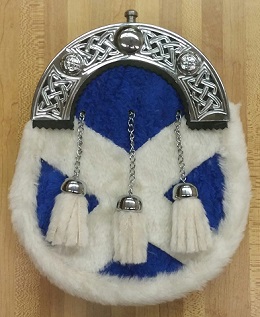
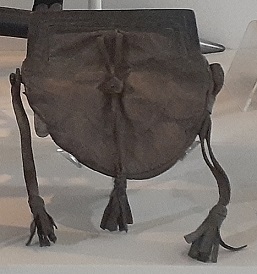
"This essential part of a Scotsman's outfit began as a humble drawstring bag of animal hide. Since kilts had no pockets this bag rode at their waist to carry their personal items.
"The bag evolved into a more intricate decoration. The basic leather sporran is generally used for day wear.
"The more dressy bag is made of animal hide with the fur left on. This can be made of goatskin, deerskin, or even sealskin.
"Instead of a drawstring closure the top developed into a flap that fastened with a thong for daywear.
"Formal wear has a cantle top with silver or gold fittings."
* Pacella 2008 p127
"... "[T]he sporran [... was] a small decorated bag worn on the belt and [was] part of traditional dress."
* Royal Armouries Museum > War Gallery
"[...] The sporran was originally a practical and secure pouch worn suspended from a belt and part of traditional Highland dress." ...
Knife
* Tarassuk/Blair 1979 p440
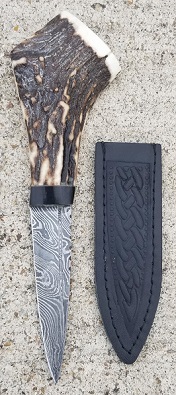
"An account dated 1737 describes Highlanders carrying a knife called a 'skeen ockles' -- a 'sleeve knife' -- in addition to the dirk, although its exact form is unknown. Some short daggers with carved wooden handles which survive from , probably the latter part of the 18th century do, however, differ in form from the dirk, and it has been suggested that these may be the 'sleeve knives' referred to above."
* Wallace 1970 p78 f77
"Knives do exist that are patently too large to have been carried as part of dirk furniture. The one illustrated here was, because of its provenance, considered by Whitelaw to be a true relic of the battle of Culloden. Possibly it may be the kind of knife that Edward Burt refers to in his Letters from a Gentleman in the North of England, completed in 1737 and published in 1754. Here he says that 'some of them [the Highlanders] carry a sort of knife which they call a skeen-ochles, from its being concealed in the sleeve near the arm-pit'."
* Cannan 2009 p95
"[T]he sgian dhu ('black knife') ... was probably not worn in the sock before Victorian times -- instead it was sgian achlais, the 'armpit knife', so-called (the Englishman Edward Burt noted in the 1730s) because it was kept 'concealed in the Sleeve near the Arm-pit.'"
* Neumann 1973 p231
"The Sgian Dubh It was also the practice by many Scots to carry a small companion knife to the dirk. References in the first half of the 18th century describe its popular carrying place as in the sleeve near the arm pit."
* Culloden 1996 p94
"Skean dhu (Gaelic, sgian dubh = black knife) Highlander's small knife worn in the top of his stocking."
Jewelry
*
"