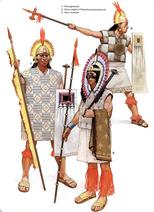
Subject: kuraka noble warrior
Culture: Inca
Setting: Inca empire, Andes 1438-1572
Evolution:
Context (Event Photos, Primary Sources, Secondary Sources, Field Notes)
* Wise/McBride 1980 p23-24
"As with the Aztecs, the term 'Incas' did not originally have the meaning which we now apply to it. By about A.D. 1000 a tribe called the Quechua had occupied the valley of Cuzco in modern Peru and gradually expanded their hold on the surrounding territory, absorbing or killing their neighbours. Around A.D. 1200 the chieftains of the Quechua declared that they were descended from the Sun God, and would henceforth be hereditary and divine rulers. They called themselves Incas, but their tribe was still called the Quechua, and Quechua-speaking Indians survive in Peru to this day.
"The Incas reached the zenith of their power during the 15th century, and never lost a battle after 1437 -- until the Spaniards arrived almost a century later. By 1500 the Quechua people had absorbed about 500 other tribes and the Incas ruled an empire five times the size of modern France, covering not only Peru but also Ecuador, southern Colombia, part of western Bolivia, and northern Chile. The Quechua were still the main ethnic group in this vast empire, but there were three other major ethnic groups: the Symaras to the south, the primitive Urus from the Amazon Basin, and the Chimus along the coast north of Lima. This last group was the final one to be conquered by the Incas, in a prolonged was lasting from 1461 to 1464, which made such an impression on the Quechuas that they were still talking about it when the Spaniards arrived.
"[...] To achieve this dominance over such a vast empire the Incas needed a large and well-organized army. Most able-bodied males were trained in the use of arms from boyhood, with regular drills two or three times a month, and could expect to be called up to perform their military service whenever needed between the ages of 25 and 50, but there was no standing army. Instead, when war was imminent, each province was ordered to send a contingent of warriors under a local commander, and these tribal contingents either marched to Cuzco or waited in readiness to join the main army when it passed near their territory."
* Quilter 2005 p216
"kuraka (koraka, curaca) An 'official,' which the Spanish used for Inca government officials and local native lords or leaders. The Caribbean term cacique was sometimes used for chiefs and orejones, or 'big ears,' (higher status people wore larger ear spools) for Inca officials."
Headwear
* Rowe ed. 2011 p88 (John Howland Rowe, "Ecuador under the Inca empire" p70-95)
"Two kinds of headbands are mentioned in the sources. One, associated with the Cuzco area, is a long braided band, called a llawt'u, written llauto by the Spanish. Men of higher status often had some sort of ornament tucked into the llawt'u over the forehead. The second type of headband, called pillu, written pillo by Spanish writers, is defined as a plump (rollizo) circlet (corona or rodete) of wool. The geographic range of the pillu is unclear, but it is mentioned as being worn in Quito. Circular fringed headbands, called pillu, have also been preserved in some Bolivian communities. Men who were ethnic Incas wore their hair very short, and noblemen also wore large earspools, but elsewhere hairstyles and jewelry were variable." [references omitted]
* Fashion, costume, and culture volume 2 2004 p403
"The weaving tradition, so important to the Incas, helped create beautiful woven headdresses. Inca emperors wore woven hats trimmed with gold and wool tassels or topped with plumes, or showy feathers. Incas also created elaborate feather decorations for men: headbands made into crowns of feathers, collars around the neck, and chest coverings."
Costume
* Stone-Miller 2002 p210-212
"The Incas cared most about the fine cloth they called qompi (in fact, when recording numbers of items in the census, the Inca first listed human subjects, then camelids [whose fur made most cloth], then textiles themselves, before foodstuffs or gold). There were two levels of qompi, good cloth woven by male qompicamayocs (keepers of the fine cloth) as tribute, and the best cloth made by the acllacuna for royal and religious use. Control over the finest textiles was an obvious priority as they served to adorn the ruler, grease the most important political wheels, and even to propitiate the sun (qompi were burned as sacrificial offerings). One offers only the most prized possessions to the highest spiritual powers. At its best, Inca weaving is unsurpassed technically in the pre-industrial era, with thread counts reaching several hundred per centimeter.
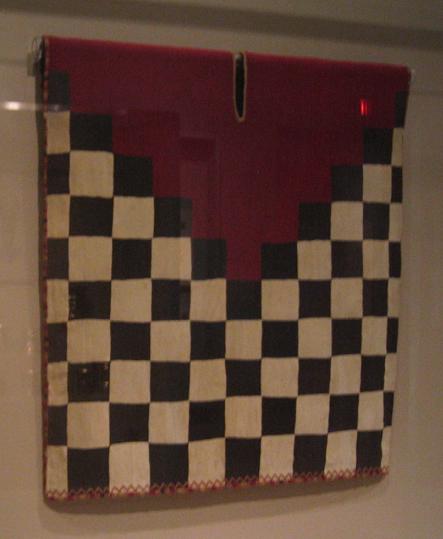
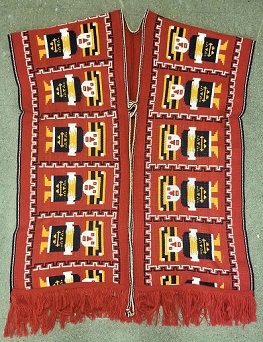
" .... The square geometric designs known as tocapus, reserved for elites and usually only seen in small bands, broadcast the message that the ruler controls more diversity, more ethnicity, almost the totality of possible patterns in his clothing. By contrast, lower-status tunics are limited to a single motif. [CONTRA Wise/McBride 1980 p38 below.] The ruler is above the rule of regularity as well, since these motifs and their coloration do not repeat in any order, while those of lesser tunics follow strict checkerboard and stripe patterns. Standardization applies to lower status textiles even in the number of squares per row. Non-royal clothing was an instrument of conformity, unmistakably signaling imperial power. Imagine 10,000 warriors in checkerboard tunics advancing over the hill! The graphic boldness of simple, high-contrast geometry is thus both aesthetically pleasing and politically effective. Motifs make only rare, tangential reference to pre-Inca styles (stepped diamonds come the closest to a Wari model) and so proclaim the universal, elemental quality of Inca rule."
* Wise/McBride 1980 p24
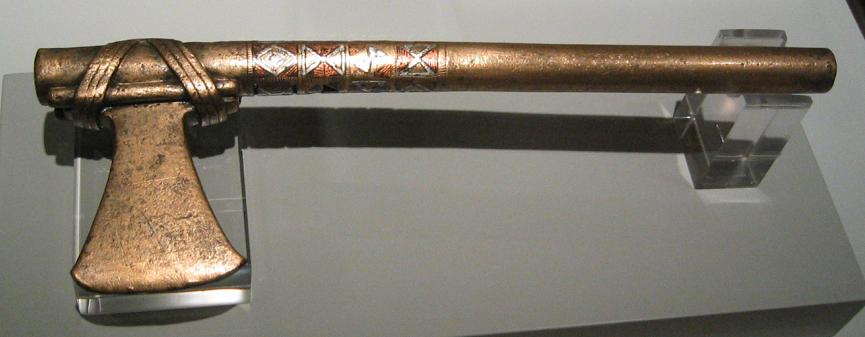
"The élite corps provided a bodyguard for the Inca, as well as officers for the whole army, and also fought as a unit in battle. The strength of the corps is not known, but it is not believed to have exceeded 10,000. Only the sons of the two nobilities [Tuc-ri-cuos and Curacas] could enter the corps, at the age of fourteen. There followed four years of training, culminating in six days of tests of endurance, skill and courage. Those who passed received a breechclout, sling, shield and silver-headed axe, and had their ears pierced to receive gold ear plugs which would ultimately be up to 50mm (2in.) in diameter. These plugs so stretched the ear lobes of the nobility that the Spaniards called the nobles Orejones -- 'Big Ears'. They were also entitled to wear the llantos or royal fringe, a braided circlet worn round the head." [CONTRA Wise/McBride 1980 p38 below.]
* Wise/McBride 1980 p38
"The dress and armament of the warrior cast in Peru, from Inca down to the lowest Curacas, was almost identical."
* Rowe ed. 2011 p87-88 (John Howland Rowe, "Ecuador under the Inca empire" p70-95)
"Cieza de León ... describes the male costume in Panzaleo ... :
They wear tunics (camisetas S) without sleeves or collar, with openings at the sides for the arms and at the top of the head, as well as large wool mantles and some of cotton. And the costume of these lords was very superior, with many colors and very perfect. For shoes they wear some oxotas [usut'a] of a root or grass they call Cabuya, which is from large fleshy leaves, from which they derive white fibers like hemp, very strong and useful. And from these they make their oxotas or sandals (albarcas S) [modern alpagarta], which serve them for shoes. And on their heads they wear cords (ramales S).
"Other Spanish authors note that Inca tunics were knee-length, as confirmed by archaeological examples. They are usually made of a single piece of fabric with the neck slit woven in. It is clear from artistic representations that they were worn unbelted. The finest tunics were tapestry woven, but plainer ones were worn by ordinary people.
"Although the usual Spanish word for tunic is camiseta, the Inca term used around Cuzco is unku, and the dictionaries give cusma (kusma) as the Chinchay Suyu term. Cusma is used in Atienza's 1570s account of men's costume in the Quito area, and kushma is the usual modern term throughout highland Ecuador for a tunic or a tunic-derived garment.
"The Inca man's mantle (called yaqolla) was rectangular, made of two panels, and undecorated except for the edge binding. It was worn loosely draped or with two corners knotted together. Inca men also wore a small shaped breechcloth (wara).
* Bergh 2012 p159
"By the time of the Inca Empire, tapestry-woven textiles were classified as cumbi (also spelled 'qompi'), a category of treasured, superior-quality cloth that Inca royalty claimed as their exclusive privilege, whether for personal wear or to bestow as esteemed gifts to strengthen bonds of loyalty. In the early years following the conquest, Spanish commentators shared this enthusiasm for cumbi, which they uniformly ranked as finer than European cloth and admired for its exquisite, silk-like softness and technical refinement."
* Yarwood 1978 9240
"Men wore a loin-cloth and, sometimes, a short tunic or robe. Outer clothes were wraps or cloaks in the design of an Arabian burnous or a poncho."
* Weber 2005 p8
"Throughout the Inca Empire, people at all levels of society wore the same style of garments, but the cloth from which these garments were made revealed the wearers' wealth and origins. In the warm coastal lowlands, the Incas preferred cotton clothing, which kept their bodies cool. Inhabitants of the colder mountain regions wore clothes made of alpaca or llama wool. On their feet the Incas wore grass shoes or llama leather sandals bound with brightly colored wool fastenings. ...
"Tunics and Tocapus Inca men wore a loincloth, a long strip of cloth that went through the legs and wrapped around the waist to secure like a belt. In hot weather they wore this alone. On top, men wore a sleeveless, knee-length tunic made from one piece of cloth, with a slit cut through the middle to make space for the head. The waistlines of Inca tunics were often decorated with tocapus, which revealed information about the wearer, such as his wealth, birthplace, or status. Men also wore embroidered sashes around the waist. In cold weather and on formal occasions, men wore a loose cloak over a tunic, tying its two corners in front, at the neck. Instead of using pockets, men carried their tools, amulets, and coca leaves in small bags."
Axe
* Wise/McBride 1980 p28
"The axes had stone or bronze blades set into wooden handles of varying lengths. There was a short hand axe called champis, but some had hafts so long that they more nearly resembled a halberd."
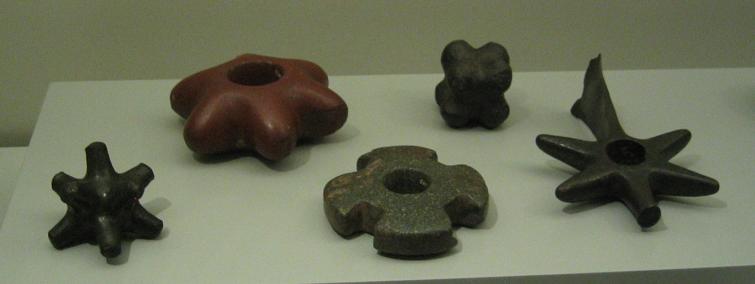
Mace
* Wise/McBride 1980 p27-28
"The clubs or maces had wooden handles about 80cm (31 in.) long and a circular head of stone or bronze with six projecting points."
* Stone 1934 p185
"The ancient Peruvians used ... clubs .. with rings or stars of copper on the ends instead of stone balls." [CONTRA Wise/McBride 1980 p27-28]
Jewelry
* Fashion, costume, and culture volume 2 2004 p403
"[W]ealthy Inca men wore large gold and silver pendants hung on their chests, disks attached to their hair and shoes, and bands around their arms and wrists."
Footwear
* Rowe ed. 2011 p87 (John Howland Rowe, "Ecuador under the Inca empire" p70-95)
"Inca sandals ... are described as having untanned leather or braided cabuya soles and camelid-hair ties."