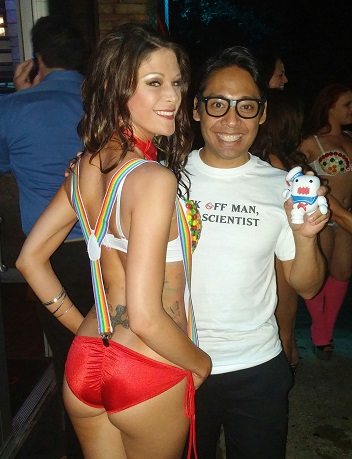
Subject: nerd / geek
Culture: American / global
Setting: academia, tech
Context (Event Photos, Primary Sources, Secondary Sources, Field Notes)
* Anderegg 2007 p20
"Wikipedia tells us that a nerd is 'a stereotypical or archetypal designation.' It 'refers to somebody who passionately pursues intellectual or esoteric interests such as books and video games rather than having a social life, participating in organized sports or other mainstream activities. The Merriam-Webster definition is an 'unstylish, unattractive, or socially inept person; especially: one slavishly devoted to intellectual or academic pursuits.'"
"[...] The terms 'nerd' and 'geek' are practically synonymous in some contexts and slightly differentiated in others. Since there is really no such thing as a nerd or a geek, we can't do what many scientists do: We can't find the prototypical member of the species and then use that prototype to define all the central characteristics. We can't really answer with any finality the question about whether nerds and geeks are really two variants of the same thing, like Baltimore and northern orioles. In fact, we might observe that this is, in itself, a geeky question."
"Nerd is the word There’s been a bit of debate around where the word “nerd” actually came from. One theory suggests that it was a nonsense word first used in Dr. Seuss’ “If I Ran a Zoo”, an alternative way of saying “nert,” which meant “crazy, stupid or nuts.”
"Another argument pushes the idea that the word came from a backwards reading of “drunk”, describing a person who’d rather study than party with the cool kids. While there’s no universally accepted definition for the word, it was clear how to describe what a nerd was in the 1950s. American students coined the term to describe a person with their head in the books, either studying or invested in some otherworldly narrative. They were the uncool individuals relegated to the lower tiers of a school’s social hierarchy.
"What is the difference between a geek and a nerd? Although people will use the terms interchangeably today, a geek and a nerd have historically had slightly different meanings. Nerds were individuals considered highly intelligent in a specific subject. In contrast, geeks were those who expressed a profound love for their hobbies. Popular media refined the stereotype of a nerd, with characters from popular TV shows in the 60s and 70s, like “Happy Days”, showing them as people who didn’t fit into their “cool” vision because of their non-rebellious ideals and perceived weaker physical stature.
"But nerds had their own culture brewing as a result of that perception. Many would dive into novels, films and physical games as a means of escapism from the provocations that came with being a nerd. Early publications include the fantasy novels of J.R.R. Tolkien, like the “Lord of the Rings”, the British science fiction television series “Doctor Who,” and Stan Lee’s superhero comics at Marvel. Many of the themes portrayed heroism, magic, technology, alternative societies and others that often intertwined with a nerd’s social struggles.
"Nerds themselves would write and create as a means of expression. It wasn’t long before these works would find their audience, building communities that bonded the demographic and planted the roots of a culture, ultimately falling into the description of a geek."
"Jerry Lewis portrayed a hapless scientist in 1963's The Nutty Professor. By the 1970s, Happy Days cool guy Arthur 'Fonz' Fonzarelli was lobbing nerd around as an insult, saying in one episode that there are two types of people: 'cool and nerds.'
"The following decade solidified the stereotype. In 1984 the cult classic Revenge of the Nerds was released, pitting a group of outcast college students against their jock tormentors.
"But around the end of the 20th century, nerd culture assumed a more respected spot in American culture. The computing revolution made Bill Gates and Steve Jobs — and later internet startup CEOs — household names. Rock bands like Weezer sported thick-rimmed glasses. And you've seen the Star Wars movies, right?
"Mathew Klickstein, a pop culture historian, author and filmmaker, said the 90s independent film movement and indie rock trends started making "the weirdos, the misfits, the outsiders, the nerds, the geeks, cool." He noted that it even spawned 'nerdy geek chic' fashion styles and more.
"'There's questions now about, has the tail wagged the dog at this point,' Klickstein said. 'Are there people who are claiming they're nerdy, claiming they're geeky, who really just are vaunting or emulating the style without really understanding the substance?'
"The nerd goes mainstream In recent decades, art forms that once may have been considered the realm of nerds — comic books, science fiction, video games — have exploded in popularity across the U.S.
As Parks and Recreation's Ben Wyatt once said in a moment slightly lacking in self-awareness: 'You know, nerd culture is mainstream now, so when you use the word 'nerd' derogatorily, it means you're the one that's out of the zeitgeist.'
"The popularization of nerd culture has also dovetailed with an expanded definition of the word itself.
"Now you don't have to wear a pocket protector and be into computers to qualify as a nerd. Nerds are simply people who are really into a certain thing.
"Merriam-Webster defines a nerd as 'an unstylish or socially awkward person.' But the first definition on its website characterizes a nerd as 'a person devoted to intellectual, academic, or technical pursuits or interests' or 'a person preoccupied with or devoted to a particular activity or field of interest.'
"According to Omar Holmon, an author, content creator and co-founder of the website Black Nerd Problems, 'it could be a fan for a spectrum of things, and that spectrum being literally anything. It's whatever you are passionate about.'
"Holmon said nerds strive to spread their enthusiasm to others. 'How can I get you to care about this thing that you don't know about, that I know about? And hopefully you'll be as passionate about it as I am.'"
* Nugent 2008 p10-11
"The linguist Mary Bucholtz has observed that some contemporary high-school students who consider themselves nerds cleave so tightly to American Standard English, even as popular white kids cultivate hip-hop affectations, that they engage in what she called 'hyperwhiteness' -- whiteness so white it destroys the aura of normality that usually attends white people. The history of the concept of nerdiness helps show some of the ways we have thought about the primitive, the 'Oriental,' white people, Jews, nature, and the machine.
"'We' here does not mean 'Americans.' Rosie Shuster, Lorne Michaels, and Elvis Costello -- two Canadians and an Englishman -- all made their mark on the history of the nerd at the same pivotal moment. Tokyo is the city where otaku, a type similar to the American nerd, has its own neighborhood, Akihabara, known for waitresses who dress as manga characters. In England, the word boffin has been around for centuries. Theories about the fine differences in meaning between geek, dork, and nerd in Silicon Valley and other tech hives are all over the Internet, but, internationally, the nerd/otaku/geek/dork is a concept that involves: loneliness; the rote, mechanical nature of work in the industrial and postindustrial ages; the way modernity allows the body to fall into disuse; and the way contemporary mass media invite people into voyeuristic relationships with simple fictions and numb them to the pleasures of real life. To understand nerds is to enrich our understanding of many demons."
* Martin/Koda 1989 p38
"The nerd has also become a sexual creature, vulnerable and feeling, a perfect partner because he is not only concerned with himself. In the film Revenge of the Nerds (1984), a young woman commends one of the characters on his sexual performance, and he reminds her that nerds don't spend their spare time in self-centered exercising to keep themselves muscular; they think about sex. A male counterpart to Cinderella, the nerd blossoms in a seductive relationship with a woman."
Costume
* Nugent 2008 p11
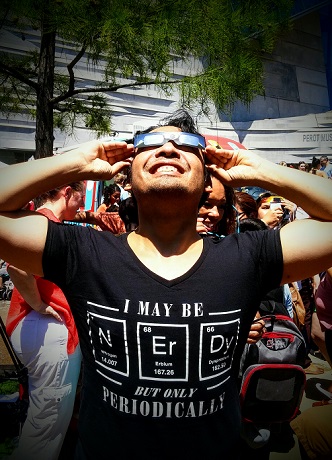
"Beyond the traits that fit into an intellectually defensible definition of nerd, a nerd aesthetic. You know it when you see it: the indestructible-looking but nonetheless largely destroyed glasses, the pair of pleated shorts that exposes thigh, the childlike laugh, the intense self-seriousness. These are the universally acknowledged symptoms, and it's worth tracing how they come together in a chain of pop-culture images."
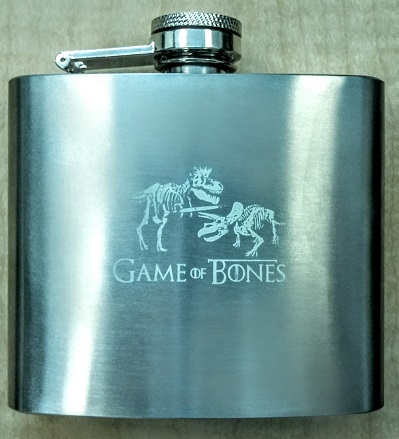
Flask
*
"