Subject: pirate
Culture: American
Setting: North America
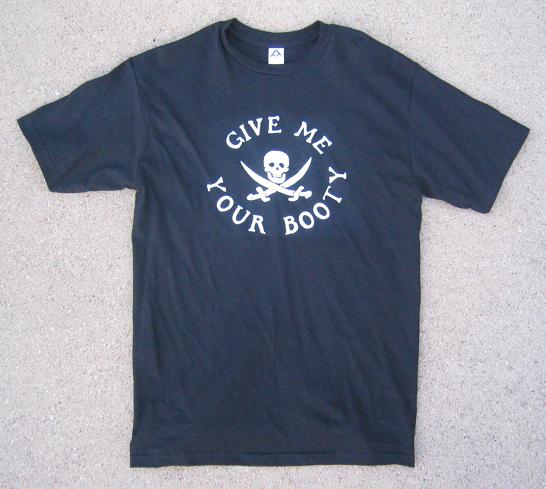
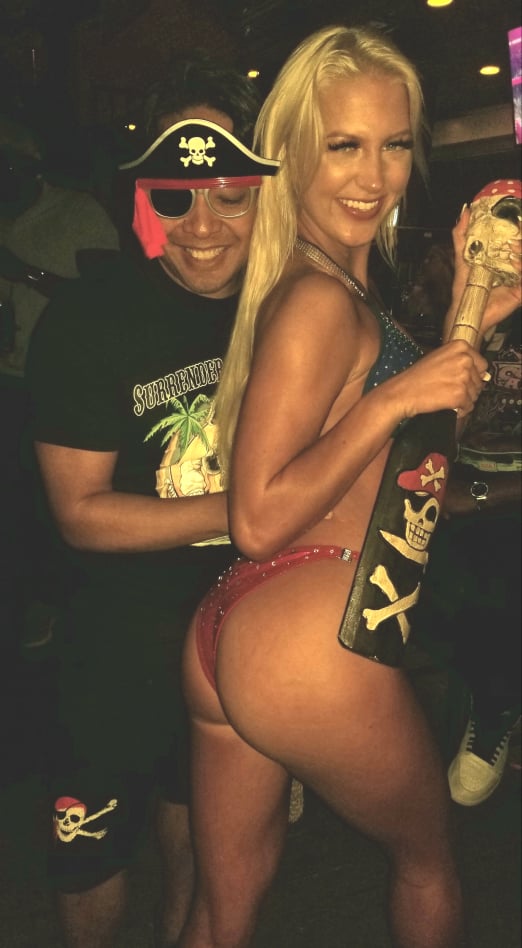
Context (Event Photos, Primary Sources, Secondary Sources, Field Notes)
"Americans are fascinated by pirates: swashbuckling, salt-soaked seafarers who sport blousy shirts, spiffy vests, leather boots, eye patches, peg legs and the occasional parrot on the shoulder. There is romance in burying booty marked by a bloody X on a map and in making enemies walk the plank.
"There is something so timeless about piratical behavior — living the lawless life, stealing from the rich, sticking it to "The Man."
[....] "The pop-cult obsession with piracy dates back even before Robert Louis Stevenson's classic 1883 tale Treasure Island. Shomette says it all started with a 1724 book by Capt. Charles Johnson (perhaps Daniel Defoe writing under a pen name) titled A General History of the Robberies and Murders of the Most Notorious Pyrates. The author interviewed pirates and painted a world of skullduggery on the high seas.
"Over the years, American cinema has glorified piracy, thanks to legendary actors such as Errol Flynn and Burt Lancaster. Steven Spielberg cashed in on the action with Hook. And Disney, seizing on piracy preoccupation, produced smash movies such as Treasure Island and Peter Pan before hitting the jackpot with the Pirates of the Caribbean films."
* Kayti-Burt 2023-09-01 online
"In our culture, most depictions of pirates — fictional, historical, or both — have been directly inspired by a specific subset of pirates: white, European male c aptains living during the Golden Age of Piracy, between the 1650s and the 1730s. (Think Blackbeard, Captain Kidd, and Calico Jack.) Most of this narrow depiction of pirates can be traced back to one book: A General History of the Robberies and Murders of the most notorious Pyrates. Published by Captain Charles Johnson (believed to be a pen name for Robinson Crusoe novelist Daniel Defoe) in England in 1724, the book contained (perhaps exaggerated) biographies of famous pirates. It introduced concepts including the Jolly Roger, pirates with peg legs, and buried treasure, and was a major influence for Robert Louis Stevenson’s Treasure Island and J.M. Barrie’s depiction of Captain Hook in Peter Pan. Moving forward, we can see its impact on characters like One-Eyed Willy from The Goonies or Jack Sparrow in the Pirates of the Caribbean franchise.
"[....] Compared to other historical figures, pop culture has always had a particularly loose relationship to accuracy when it comes to depictions of real-life pirates. This is probably in part because we are lacking verified historical detail about much of pirate history. “There’s not enough reliable evidence for anybody to be able to fully make cast-iron claims,” says Sam Conniff, author of the 2018 book Be More Pirate. “That’s perhaps why it’s so interesting and useful. It’s quite malleable.” In his book, Conniff uses examples from the Golden Age of Piracy, including the implementation of workers’ compensation and the acceptance of queer partnerships, as inspiration for challenging modern systems of inequality in radical and productive ways.""
"How pirates slipped into popular legend is easy to trace. Just as the Golden Age was coming to an end, a certain Captain Charles Johnson (a pseudonym that no one has cracked) published a famous compendium of the biographies of these desperados, called A General History of the Robberies and Murders of the Most Notorious Pyrates (1724). It was full of bloodthirsty detail, breathlessly narrated, and secured the legends of Blackbeard, Black Bart and a host of others. Pamphlets and broadsides detailing the terrible crimes and suitable punishments of legendary criminals have been bestsellers since printing began, and pirates were popular subjects in the early 18th Century. The author Daniel Defoe wrote several pamphlets about pirates around the time he completed his famous story of shipwreck, Robinson Crusoe (1719). Johnson’s book was a publishing sensation, and a second volume of somewhat more fanciful accounts appeared in 1728.
"Johnson’s book has been the source of nearly every cultural representation of the pirate ever since. It is easy to see why, from passages like this:
"“He assumed the cognomen of Blackbeard from that large quantity of hair which, like a frightful meteor, covered his whole face and frightened America more than any comet that has appeared there a long time. The beard was black, which he had suffered to grow of an extravagant length; as to breadth it came up to his eyes. He was accustomed to twist it with ribbons, in small tails.”
"Going into battle, Johnson says, Blackbeard adorned his beard with lit matches to make himself appear “like a fury, from hell.” Brutal punishment and death is of course the outcome of his rogue adventures, but even Johnson ambiguously declares the murderous Blackbeard a “courageous Brute”. Ian McShane has memorably played Blackbeard in the Pirates films, but these evocative details already suggest sources beyond the shambolic style of Keith Richards for Johnny Depp’s Jack Sparrow.
"Johnson’s General History directly inspired Robert Louis Stevenson’s Long John Silver in Treasure Island (1883) and Captain Hook, allegedly Blackbeard’s former bo’sun, in JM Barrie’s play, Peter Pan (1904). These characters secured the pirate as a liminal figure of fear and fun in children’s fiction, but adults had long been rendered breathless by one of the first mass publishing sensations of the modern age, Lord Byron’s epic poem The Corsair in 1814. Corsair was the French term for a privateer, and Byron was particularly focused on their ambiguous status at the edge of the law: “He knew himself a villain – but he deemed/The rest no better than the thing he seemed.” This book, from the pen of a scandalous libertine poet, sold 10,000 copies on the first morning of publication. Superstar Byron, too, fused his image with the legal renegade of the pirate and that persona has suffused our conception of the Romantic poet ever since. It’s a direct line of descent down from this figure to the strutting and preening of the ‘70s rock star."
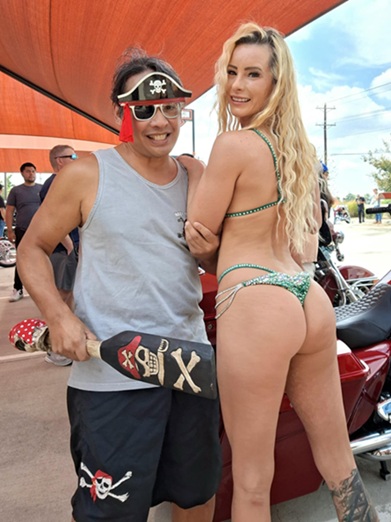
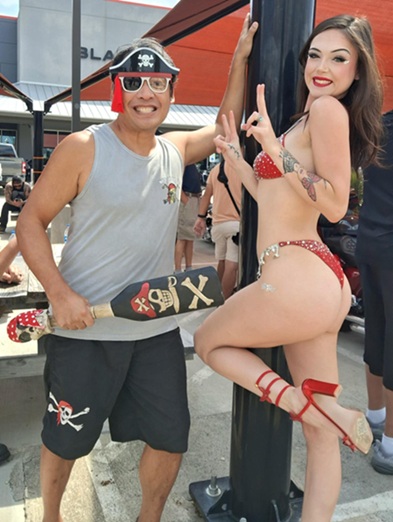
Costume
* Konstam/Rickman/Rava 2011 p18
"If a modern-day movie pirate or re-enactor were somehow transported back to the Golden Age of Piracy, he would no doubt draw some very curious looks. Today's ideas of 'pirate dress' -- including headscarves, hoop earrings and long, dangling sashes -- are myths inspired by authors and illustrators who needed to create a recognizable pirate archetype in order to tell their stories. Real pirates were sailors who had turned outlaw and there is simply no evidence that they ever dressed as anything other than seamen. But even our ideas of late-17th- and early 18th-century seamen are obscured by legend."
* Turnbull 2017 p15-16
"[T]he popular image of the pirate derives almost entirely from the American author and illustrator Howard Pyle (1853-1911). Pyle regarded the look of ordinary eighteenth-century sailors as too dull for these romantic figures, so he added elements drawn from the Spanish folk costume of his day -- headscarves knotted behind the head, large hooped earrings and wide trailing sashes -- to a somewhat mistaken notion of authentic seafaring dress."
* Konstam 1999 p184
"The modern image of a pirate from the "Golden Age of Piracy" is based on the archetypal Hollywood model. Bicorn hats adorned with a skull and crossbones plus a splendidly decorated long-tailed captain's coat are the standard attire for any pirate leader. The crew tend toward head scarves, plain white shirts, and seamen's baggy trousers, adding ear-rings and tattoos for extra effect. Although the portrayal of the crewmen is almost accurate, much of the image is carried to extremes, and the figure of Captain Hook with his wig, ruffed sleeves, and trimmed beard would have been laughed out of the Caribbean."
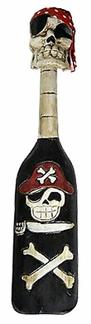
Paddle
*
"
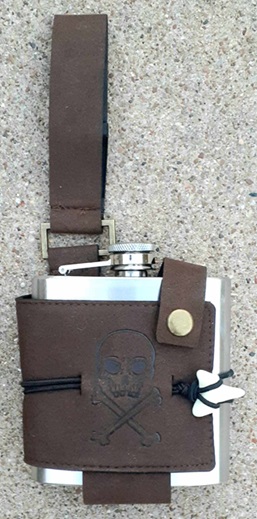
Flask
*
"