Subject: warrior
Culture: Caledonian Briton
Setting: northern Britain 1st-4thc
Caveat
* Ross 1991 p102-106
"As far as we can tell, the civilisation of the Caledonians and Maetae ... was that of the Celtic Iron Age .... The description of the people living above the Antonine Wall presented by Cassius Dio, the Roman historian of the Severan period, is as famous for its inaccuracy as for its colour:
The Caledonians and the Maetae dwell among inhospitable hills, between which the land is damp and swampy. The native people have no forts or towns, nor do they engage in agriculture; they live rather by tending herds, hunting and plucking berries from the countryside, and though there are teeming rivers and lakes all around, for some reason they do not eat fish. Tents are their only habitation. They wear neither clothes nor shoes, enjoy women in common, raise all their children [not following the practice of infanticide] and have a democratic form of government.
"The men of the tribes are warlike, enjoying nothing better than joining a raiding party to seize plunder. Their horses are small but swift and some of the warriors fight from chariots. The infantry, armed with daggers, spears and shields, are remarkably swift moving and tough: they can live for a very long time by eating only bark and roots, and they know the secret of preparing a special food which, if taken in very small quantities, relieves them of all hunger and thirst. When danger threatens they submerge their bodies in the marches and survive for days with just their heads showing above the surface.
Vivid though this picture may be, it is really a jumble of myth and distorted travellers' tales. It has to be examined with care if we are to learn anything valuable from it.
"Writing more than a century earlier, Tacitus believed that the Caledonians were no different from the other Celtic tribes of Britain and Gaul, and archaeological evidence supports this view. A society which could construct a fort as spectacular as Tap o'Noth (Gordon), store its agricultural produce in stone-built souterrains and forge fine pieces of metalwork was far from primitive, even by Roman standards. Furthermore, there is now way that the rich and comparatively well-ordered Pictish civilisation of the Dark Ages could have sprung from barren soil. Dio's stories of semi-naked nomads, therefore, may have originated from those who came into contact with groups dwelling deep in remote Highland glens, whose way of life was very different from that enjoyed by the tribes inhabiting the more fertile eastern areas. His fixation with bogs may have been from inaccurate descriptions of crannogs."
* Armit 1997 p66
"In 1968 Professor Stuart Piggott characterized the peoples of the Scottish Iron Age as 'Celtic cowboys ... footloose and unpredictable'. Their pastoral, possibly nomadic, life-style was expressed as a direct contrast to the agricultural economies of southern England where grain storage pits, granaries and fields, the paraphernalia of settled farmers, were more obvious. This view reflected the powerful influence of the classical texts: Cassius Dio, writing around AD 220, had condemned the northern tribes as having no 'cultivated lands, but living by pastoral pursuits and by hunting, and on certain kinds of berries', adding for good measure that they lived naked, barefoot and in tents.
"Sincde Piggott made his much-quoted statement a mass of new data has become available. Aerial photography has brought to light extensive landscapes of buried lowland settlement, while traces of cultivation have been found in the uplands at altitudes once unthinkable for the Iron Age. These discoveries force us to rethink the old picture of a heavily forested country where a small and dispersed population roamed with their flocks and herds. Instead, we have to imagine crowded lowland landscapes of fields, pasture, wetlands and managed woodland, and the periodic expansion of settlers into the upland pastures. Indeed, the first such expansion pre-dates the Iron Age by several centuries and seems to have taken place in the middle of the second millennium BC."
Context (Event Photos, Primary Sources, Secondary Sources, Field Notes)
"It is generally assumed that the tribes of Scotland remained completely autonomous, with the nationalistic notion of ancient Caledonii tribes holding firm against the might of the Roman war machine. But, archaeological evidence has shown that the low-land regional boundaries moved several times with many annexed tribes becoming subject to Roman rule for a time.
"Incursions into central and northern Caledonia established chains of fortifications such as the Gask Ridge (built between 70-80 AD) and exploratory marching camps encircling the Fife, Angus, Tayside, Crampians and stretching as far north as the Moray Firth (next to the modern city of Inverness).
"[....] In later years, the accepted frontier of the Roman territory and Caledonia was fixed south of the Cheviot Hills by the Emperor Hadrian with the construction of Hadrian’s Wall in 122AD. The frontier was moved further north around 142AD when the Antonine Wall was built between the Firth of Forth and the Firth of Clyde (west of Edinburgh along the central belt of Scotland).
"The Romans retreated to Hadrian’s Wall a decade later but reoccupied the Antonine wall temporarily in 208AD under the orders of Emperor Septimius Severus (this has led to the wall being referred also as the Severan Wall).
"Following the final retreat to Hadrian’s Wall, incursions by the Romans were generally limited to scouting expeditions in the buffer zone that developed between the walls, trading contacts, bribes to purchase truces from the natives, and eventually the spread of Christianity.
"The archaeological legacy of Roman Caledonia demonstrates a failed attempt at creating a Roman state through military intervention."
"The most prominent account of Rome’s campaigns into Northern Britain was written by Publius Cornelius Tacitus, the son-in-law of General Gnaeus Julius Agricola. Agricola was the commander at the Battle of Mons Graupius, fought somewhere in the north or north-east of Scotland in probably AD83. There, it is said that between 17,000 and 30,000 Roman soldiers clashed with up to 30,000 men of the Caledonian army, which brought together several Iron Age tribal groups. Tacitus described the inhabitants of Caledonia as having ‘red hair and large limbs’ who were fierce and quick to fight. Dr [Louisa] Campbell said the accounts of Tacitus must be treated with caution, not least as it serves as a "propagandist record" taken entirely from a Roman perspective.
"However, she added that Tacitus account was also “invaluable” given it provides some details of Agricola’s campaigns and control of the north and south of Britain. Dr Campbell said: “He refers to the northerners as fierce tribal warrior groups, indeed he appears to respect their prowess in his description.” Tacitus wrote: “The tribes inhabiting Caledonia flew to arms, and with great preparations, made greater by the rumours which always exaggerate the unknown, themselves advanced to attack our fortresses, and thus challenging a conflict, inspired us with alarm.”
"Leading up to the battle of Mons Graupius, Tacitus refers to their valour and vigorous character and preparedness for battle when joining of forces to fight the Roman army, Dr Campbell added. Tacitus also refers to a rousing speech rallying the gathered warriors into battle by Calgacus, who is believed to have been the de-facto leader of the Caledonians. Dr Campbell said: “Tacitus provides some hints at the physical characteristics of the northerners, describing the Caledonians as having red hair and large limbs.
""His reference to chieftains and various leaders, drawing out Calgacus as the most noble by birth and valour, speaks to some hierarchical structure to these societies, with military experience and bravery marked out as pivotal characteristics of the best leaders.”
* Ross 1991 p91
"The Celtic Caledonians, though no doubt sturdy and fearless fighters, were no match for the professional legions of Rome. The northern tribes had no training in large-scale combat, which meant that they were incapable of any subtle manoeuvres of battle tactics. The man were lightly armed, fighting half-naked, largely without body armour and equipped with swords and any other weapons they could lay their hands on. Their most feared troops were the charioteers, drawn from among the highest ranks in society. But while a charge of densely packed, wheel-knived chariots could be crucial on a level, lowland battlefield, among the rock-strewn glens of the Highlands they could prove more of a handicap than an asset. In the light of the differences between the two sides, Calgacus 'the swordsman', leader of the motley band of Caledonians, would have been well advised to follow the strategy of the previous couple of years, harassing and shadowing the enemy but refusing to meet them in pitched battle. But he must have been under some pressure to justify the summons which had been sent out among the scattered farmsteads and villages of the north, calling all men to take up arms and unite to destroy the invader. Such people could ill afford to be away from home for long. They came expecting battle and when no decisive action was forthcoming they must soon have grown restless and begun to drift back into the hills."
* Ross 1991 p94
"The success of the people of north Britain in driving the Romans from Scottish territory is a reflection not only on the temporary weakness of the invader but also on the strength and thinking of those who were able to take advantage of the new situation. It seems as if the lessons of Mons Graupius had been well learned. The fact that at first the Romans withdrew under pressure suggests that they had been subjected to consistent and effective harassment, probably in the form of ambushes on the road and sudden, violent raids upon insecure garrisons already weakened by a shortage of provisions. It is extremely unlikely that the Britons followed any sort of master plan or overall strategy, but their ability to assemble, arm and supply large numbers of men at a single point means that their forces were rather more than random gatherings of disaffected tribesmen eager for the spoils of war."
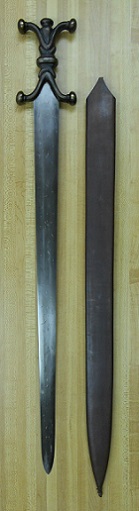
Sword
* Armit 1997 p49
"The iron swords that superseded the earlier iron versions remained the favoured weapons of the elite for hundreds of years; indeed, the name of the Celtic war leader at Mons Graupius, according to Tacitus, was Calgacus, 'the swordsman'."
* Thompson 2013 p30
"Tacitus describes the Caledonian tribesmen at the Battle of Mons Graupius using small bucklers and 'huge swords':
The Britons with equal steadiness and skill used their huge swords and small shields to avoid or to parry the missiles of our soldiers, while they themselves poured on us a dense shower of darts, till Agricola encouraged three Batavian and two Tungrian cohorts to bring matters to the decision of close fighting with swords. Such tactics were familiar to these veteran soldiers, but were embarrassing to an enemy armed with small bucklers and unwieldy weapons. The swords of the Britons are not pointed, and do not allow them to close with the foe, or to fight in the open field.
Again we can see the propagandistic nature of Classical descriptions of Celtic combat. British and Caledonian swords might have been bigger than the Roman gladius but hardly 'huge,' and the small buckler was used effectively on the battlefield for many centuries after this battle. If the Tungrian and Batavian cohorts managed to push the fight into such close-distance that the Caledonian warriors had no room to use their swords effectively, the fight might have gone something like this -- but that is no indication of an overall inferiority of weaponry on the part of the Caledonians, because the swords they were using were nowhere near long enough to be 'unwieldy' as Tacitus claims. Paul Wagner suggests that the Caledonians were using very long wooden swords, much bigger than their iron swords. This is not impossible, because we know that German tribesmen in this era fought with very long wooden swords. However, there is no direct evidence for the suggestion."
* Thompson 2013 p21
"Some of the Britons, including the Caledonian warriors of ancient Scotland, used leaf-bladed swords (meaning that the blade flared out to become much broader at the top, before tapering) estimated at about 171/2" in length."
Shield
*
"
Costume
* Ross 1991 p82
"Both sexes dressed in tunics, heavy cloaks fastened with a brooch, and leather shoes. Men wore patterned trousers tied at the ankle. For battle some may have removed all their clothes (which they also did when playing a form of hockey, known as baire) and painted their bodies, though this is unlikely to have been the custom of those fortunate enough to have owned one of the chainmail surcoats which were being made at the end of the period."