Subject: punk rocker
Culture: Scottish/Irish youth
Setting: Britain 1980s on
Context (Event Photos, Primary Sources, Secondary Sources, Field Notes)
"Celtic Punk is an Irish sub-genre of punk rock. The genre arose, not in Ireland, but in the UK, by bands who based themselves in Ireland. Common themes in Celtic punk music include politics, Celtic culture and identity, heritage, religion, drinking and being proud of the working class. Celtic punk was brought to light in the 1980s, and was always an underground genre. There is very few bands [SIC] who still work with Celtic punk, as many were never able to break mainstream.
"Many bands formed as punk bands, but soon grew tired of it and took themes from traditional Irish and Scottish music and implemented them into their music. Like many other genres of punk rock, it was used as a way of protesting."
* Hendrickson 2009-03-16 online
"When you think about Celtic music, piercing tin whistles, mournful violins and galloping bodhran drums generally come to mind. But in the last few decades, many bands have picked up The Pogues' lead by melding Celtic folk music with punk-rock energy.
"[T]he exuberant side of Celtic music ... generally manifests itself in sing-along choruses and feisty lyrics about drink, rebellion, lovely lasses and so on. So forget about 'Danny Boy,' green beer and sad songs about hard times. The Irish are old hands at having fun in the face of adversity — and, in this case, turning up the amps way up as they pogo-dance along to the beat."
"Celtic punk is essentially punk rock accompanied by traditional Irish instruments. As a musical movement, it was founded in the '80s by the Pogues, a band of punk musicians in London who were seeking to reclaim their Irish heritage.
"Celtic punk bands often play a blend of traditional Irish folk and political songs, as well as original compositions. While the plight of the Irish people throughout history is often a topic of their songs, it's not considered an overtly political movement.
"Most recently, Celtic punk is seeing a rise in popularity as American bands such as Flogging Molly and Dropkick Murphys put their own spin on the subgenre and give it a decidedly American flavor."
* Celtic Life 2022-08-05 online
"Celtic Punk Ireland proved particularly fertile ground for punk bands in the mid-1970s, including Stiff Little Fingers, The Undertones, The Radiators From Space, The Boomtown Rats and The Virgin Prunes. As with electric folk in England, the advent of punk and other musical trends undermined the folk element of Celtic rock, but in the early 1980s London based Irish band The Pogues created the subgenre Celtic punk by combining structural elements of folk music with a punk attitude and delivery. The Pogues’ style of punked-up Irish music spawned and influenced a number of Celtic punk bands, including fellow London-Irish band Neck, Nyah Fearties from Scotland, Australia’s Roaring Jack and Norway’s Greenland Whalefishers.
"Diaspora Celtic Punk One by-product of the Celtic diaspora has been the existence of large communities across the world that looked for their cultural roots and identity to their origins in the Celtic nations. While it seems young musicians from these communities usually chose between their folk culture and mainstream forms of music such as rock or pop, after the advent of Celtic punk large numbers of bands began to emerge styling themselves as Celtic rock. This is particularly noticeable in the USA and Canada, where there are large communities descended from Irish and Scottish immigrants. From the USA this includes the Irish bands Flogging Molly, The Tossers, Dropkick Murphys, The Young Dubliners, Black 47, The Killdares, The Drovers and Jackdaw, and for Scottish bands Prydein, Seven Nations and Flatfoot 56. From Canada are bands like The Mahones, Enter the Haggis, Great Big Sea, The Real McKenzies and Spirit of the West. These groups were naturally influenced by American forms of music, some containing members with no Celtic ancestry and commonly singing in English. In England we have The BibleCode Sundays, The Lagan and others."
"Celtic Punk is a genre of music that combines traditional Celtic music with punk rock. It typically features fast-paced, high-energy music with traditional instruments such as the fiddle, tin whistle, and bagpipes, as well as electric guitars, drums, and bass. The lyrics often focus on topics such as Irish history, politics, and culture. Celtic Punk bands often have a strong political message and are known for their energetic live performances."
"This is really fun music. It’s upbeat, it’s danceable (that’s a real word, it’s fine), and its lyrics often focus on stuff like politics, religion, culture, and drinking. Things that obviously go super well together in real life. Like the best moving company in Kitchener Ontario would say, The genre is always on the move. It tends to focus on the pride of the working class, which I guess is common throughout a lot of non-Celtic punk music, so it makes sense that the Celtic version would hang on to a few features. As you’ve probably guesses by the name, Celtic punk is a fusion of punk with traditional Irish or Scottish music. The more general term folk punk does include Celtic punk under its umbrella, but typically when people talk about folk punk, they are referring to music that uses English or American or some other type of folk music as its base.
"Celtic punk usually includes traditional Celtic instruments like the fiddle, bagpipes, accordion, whistle, banjo, and mandolin, alongside typical rock instrumentation. Bands of the genre will play their own, punky renditions of Irish, Scottish, or Welsh folk music or political songs, as well as their own original music, so you get a really great mix on the bands’ albums.
"Though the genre itself didn’t really come into being until the 1980s, with The Pogues, its origins lie in the 1960s and 1970s, when electric folk became a thing in England for some folk rockers, and Celtic rock became popular in the rest of the UK (that is Ireland, Scotland, and Wales). Some more traditionally Celtic folk bands such as the The Clancy Brothers and The Dubliners also have some claim to the origins of the Celtic punk genre. It is widely accepted that the first punk bank in the UK to add a traditional Celtic element to their music was a band called The Skids, who hail from Dunfermline, Scotland. These inclusions are evident on their album Joy, released in 1981.
"Around the same time, that is, in the early ‘80s a couple guys who would later become The Pogues were trying out some new sounds in London. Officially founded in 1982 in King’s Cross, London, The Pogues’ early music includes both traditional Irish songs as well as some originals that were written in the traditional Irish style, all of which were performed with a punk sound. Fun fact, the band was originally called Pogue Mahone, which is an anglicisation of póg mo thóin, which, translated from the Irish, means “kiss my arse.”
"Not only did The Pogues kick off the Celtic punk tradition in the UK, they also inspired a lot of other, newer Celtic punk bands, including some from North American, including Flogging Molly and The Dropkick Murphys. Most North American Celtic punk bands are influenced by other forms of American music, and some don’t actually contain any members with any kind of Celtic ancestry. That said, there is a large population of Irish-Americans, especially in Massachusetts, and it is form Massachusetts, incidentally, that the Dropkick Murphys hail. They are quoted as saying that they eventually came to realise that growing up with traditional Irish music influenced their sound more than they realised, and you can definitely hear that influence in their music, and in the music of the entire genre."
Hair
* Punk! 2012 p136
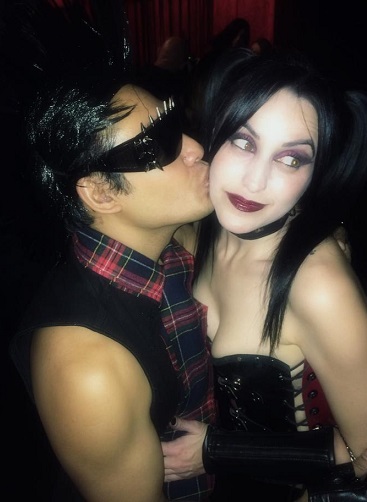
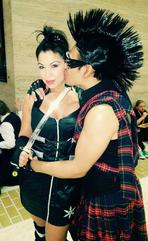
"Early punks commonly cropped their hair and made it look messy or dyed it unnatural colours. Later, the Mohican -- Mohawk in the USA -- began to gain favour."
Costume
* Young/Matin 2017 p84-85
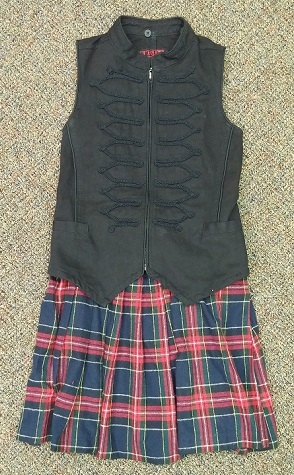
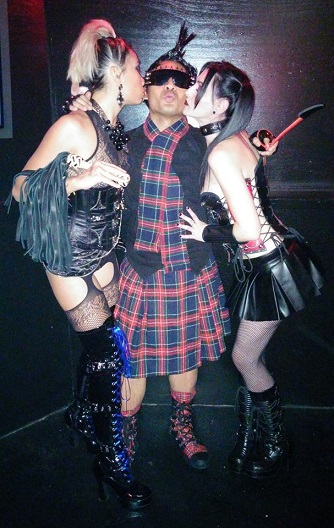
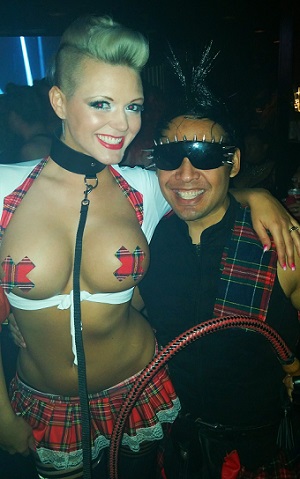
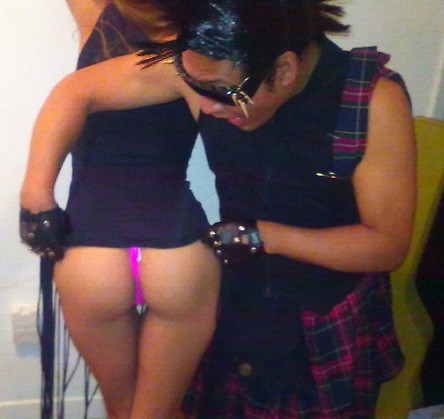
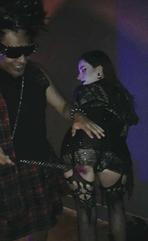
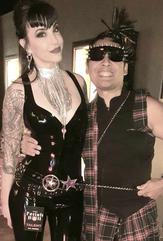
"The British punk movement of the late 1970s mixed tartan with leather, ripped nylon and vinyl for an anti-Establishment look that sought to evade class systems. Punks favoured the Stewart tartan, with its subversive historical links, worn ripped, in strips mended with safety pins worn in trouser form or as adapted kilts mirroring the Sex Pistols' cover for God Save the Queen, which featured a defaced image of Queen Elizabeth II, used on T-shirts by Vivienne Westwood. As the styles of different tribes became intertwined, a time of cultural change began in Britain. The movement was led by pioneers such as Malcolm McLaren and Vivienne Westwood, and encapsulated music, art and politics. Westwood was a trend leader, mixing tartan with spiked dog collars, safety pins and bondage wear, embodying the style revolution taking place around their Kings Road boutique. Experimentation with tartan and clashing patterns was a powerful statement with 'people wearing fancy dress and old clothes, just like they did in Paris in 1972 ... with these clothes, you want to look rakish, you want to look like you can walk down the street feeling like you own it and you're Jack-the-Lad.'"
* Banks/de la Chapelle 2007 p270
"... British punks used tartan as a form of protest against the establishment."
* Horwood 2005 p158
"[I]n the 1980s, punks added tartan to their wardrobes of leather, chains, studs and Mowhawk hairstyles -- creating just about the strangest interpretation of Scottish clanhood ever seen."
* Punk! 2012 p142
"Tartan was [a] ... popular material with punks, who often wore short kilts over bondage trousers."
* Young/Martin 2017 p205
"Royal Stewart tartan was perhaps the preferred fabric for punks because it was so easily available from charity shops and bargain bins. A kilt could be customized and modified and the safety pin appropriated for use elsewhere. The tartan also acted as a a symbol both of rebellion and of the Establishment. The Royal Stewart is the queen's official tartan, while also championed by rebels during the Jacobite uprisings, who fought for the House of Stewart."
* Punk! 2012 p168
"Kilts, both full-length and short, became a favourite form of dress among punks, who wore them over tartan or other trousers. A bum flap was a popular addition to a pair of bondage trousers."