Subject: tesumajipic warrior
Culture: Asmat
Setting: tribal warfare, Casuarina Coast 20thc
Evolution:
Context (Event Photos, Primary Sources, Secondary Sources, Field Notes)
* Meyer 1995 v1 p81
"The Asmat live in what might well be described as the worst place on Earth. Torrid jungle and muddy swamps infested with malarial mosquitoes are their everyday habitat. Their renown as artists is equalled only by their infamy as ferocious head-hunters; indeed, it has even been suggested that their seemingly compulsive preoccupation with warfare and art was a direct result of their desire to contain, subdue or simply forget their environment. The geographically hostile coast and its physically dangerous inhabitants are frequently mentioned in early texts, and the traveller was advised not to land anywhere along the Casuarina Coast, as Asmat territory was then called."
* Smidt ed. 1993 p18-19 (Dirk AM Smidt, "The Asmat: Life, death and the ancestors" p15-26)
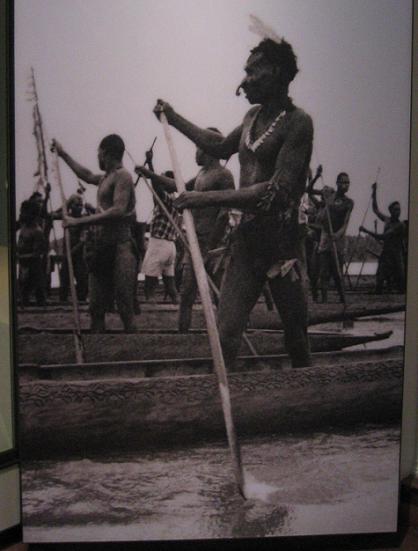
"In its day, a head-hunting expedition was a very powerfully charged event, a time of great danger and great reward; a time when the spirits seemed most present. The Dutch colonial government, and later the Indonesian government frowned on head-hunting and the practice has been formally banned since the first Dutch presence in the region. However, head-hunting still persisted among the coastal Asmat up until perhaps the early 1960s, and among the Asmat of the more remote areas, until perhaps quite recently. Even today, there are areas in the foothills between the Asmat area and the highlands where head-hunting is likely still going on among unacculturated groups."
* Smidt ed. 1993 p19-20 (Dirk AM Smidt, "The Asmat: Life, death and the ancestors" p15-26)
"There is no such thing as dying a natural death among the Asmat. Even if death comes about because of illness or through an accident, the event is always determined by magic or the spirits. A person dies because he or she has fallen victim to the evil intentions of someone else, someone who through magic and supernatural power has weakened the body and spirit of the deceased. In other words, an enemy. If every death is caused by the spear or black magic of an enemy, then the importance of vengeance for the Asmat becomes more clear.
"[...] Women would urge men to avenge the death of a husband, father, brother or son. If a man did not yield to this pressure, he became the object of derision, was proclaimed a coward, and all sexual favors were withheld from him. On the other hand, a successful warrior saw his prestige -- both sexual and social -- increase tremendously.
"The cycle of revenge was fueled by social pressure, prestige, fear -- of the souls of the unavenged dead, who wandered unhappily, causing trouble -- and even simple anger. But the underlying justification for head-hunting was to maintain the life force of the community. For the Asmat, this life force was tied up with the fertility of the crops, particularly the stands of sago, on which one depended for food. For example, if the sgo grounds were producing poorly, or game was scarce, then the community leaders might decide to hold a headhunting raid."
* Langness/Weschler eds. 1971 p277 (Gerard A Zegwaard, "Headhunting practices of the Asmat of west New Guinea" p254-278)
"It is impossible to compliment someone without referring to his achievements. The usual titles are: juus aptsjam ipitsj, man with soul, courage; aretsjar ipitsj, great man; nao pimir ipitsj, man of frequent killing; kus fé juro ipitsj, man with large bunch of skulls; tsjesesema ipitsj, good shot. These names indicate social standing."
* Rogers 1970 p22
"Warfare to secure heads is vital to Asmat ritual life. Another major reason is to preserve territory and therefore food supply. Finally, warfare is carried out in retaliation for the murder of relatives."
* Pitt Rivers Museum online > Asmat shield (1970.18.1)
"Although headhunting no longer continues, historically the practice was considered vital to the Asmat for several reasons. One's decapitated relatives demanded revenge, and caused a man misery until he avenged them. Similarly, until a man sought revenge, he was widely ridiculed by those around him and could not find a wife. The Asmat, living in regions of mangrove, rainforest and swamps, are highly dependent on their environment. Since heads were perceived to ensure the community's agricultural fertility, they were hung up in the sago palm plantations to magically fertilise them. Heads also played a central part in boys' initiation rituals, where each boy became the reincarnation of an enemy victim, whose head he had been given. He carried the deceased's name for the rest of his life, and was even viewed as the deceased by the victim's relatives".
* Campbell 1991 p109
"Up until as recently as twenty years ago, Asmat warriors used to apprehend unwary strangers on the river, truss them up, and throw them from canoe to canoe.
"Women waiting on the river bank would drage the captives to the longhouse, where they might be beheaded and eaten, to appease the ancestral spirits of the clan."
Headdress
* Chenevière 1987 p102
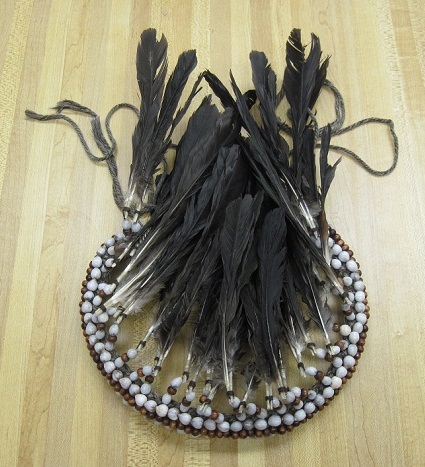
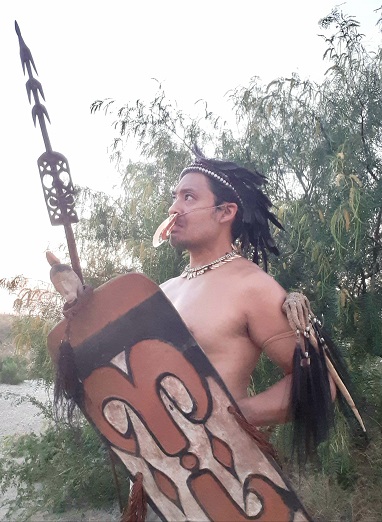
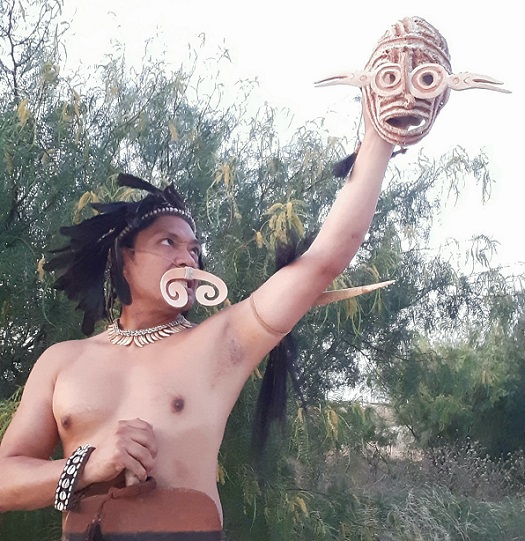
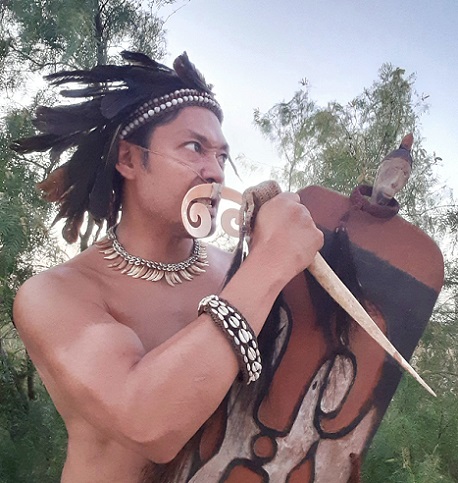
"For every important occasion in their lives, during ceremonies and in wartime, the Asmat decorate themselves: first with paint -- predominantly white, obtained from sago flour or the lime from burnt seashells; then with feathers on their heads -- the multicolored plumage of birds of paradise, the white of cockatoos, the tapered black feathers of the cassowary ...."
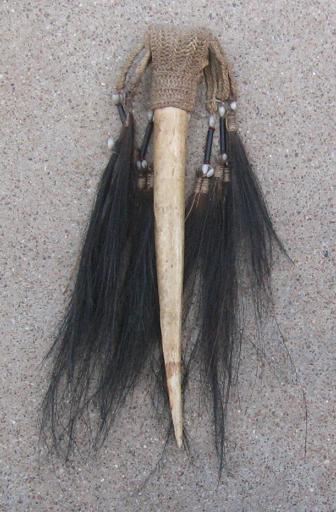
"Woven or beaded belts and vests, and feather headdresses are worn by men only. However, the hats made of cuscus pelts are worn by both men and women. They are tied around the head similar to a bandanna with the widest part at the forehead. Both men and women wear decorative hair pins made of a slender piece of wood with feathers and beads on one end."
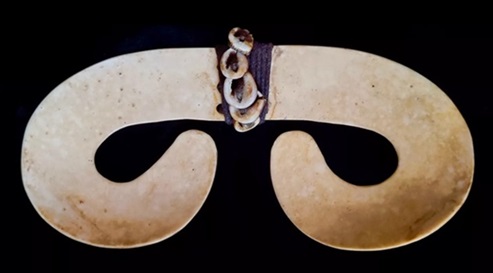
Nosepiece (Bipane, Otsj)
"Nosepieces are normally worn by men, but sometimes women as well. They are a traditional decoration for ceremonies and feasts, but may also be worn daily as a matter of personal preference. They make different types of nosepieces. One type is made from two shaped pieces of shell fastened together to resemble curved pig tusks. This type is called a bipane, and the design is often carved on shields, drums and other items. The other kind is made from the hind leg bone of pigs. These are often carved with openwork designs, and flare at the ends. This variety is called an och or ofeiti."
* Rogers 1970 p20
"Shell and bone are used for nose ornaments" ....
Necklace
* Eyde 1967 p59-60
"Dogs ... provide one article of great importance to the Asmat. When they die, or are killed, their teeth, and particularly their canine teeth are strung to make dog's tooth necklaces. These necklaces, juwur sis, literally simply 'dog's teeth,' are among the most common, and most valued, of Asmat adornment. Like most adornment they are usually worn by married men, but are also worn by women on special occasions, as when the women take part in some ritual event."
"Dogs’ Teeth Necklace: ... In past headhunting days, many items were used to remind the people in the village of the need to avenge a death. These items were collectively called etsjo pok. One of these was a necklace made of dog’s teeth. It was named for the person to be avenged, and was worn as a constant reminder. It could be worn by a family member of the deceased, or given to others. When someone accepted the dog teeth necklace as a gift, it was understood that when the time came they would help the avenger in his attack." [reference omitted]
Spear
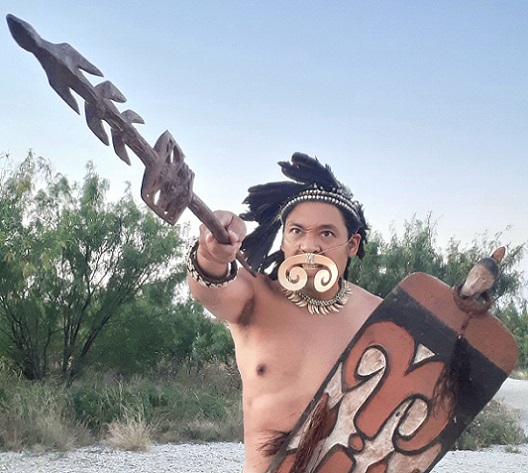
"Spears are made of wood and were traditionally used in warfare as well as hunting. Most spears have a single point, but some have a trident or harpoon shaped tip. A few also have cassowary claws attached to the points. Most have barbs carved just under the point to cause additional damage to the victim or prey when they are removed. Many also have decorative panels at the neck. The shafts can be plain or have sections of carved designs.
"Some spears also have a decorative sheath near the end. Only warriors with an established record of killing in warfare are allowed to add these ornaments. The covers are made of crocheted plant fibers, with decorative feather tassels from various birds. The tassels may also have cassowary quills or seeds as beads."
* Eyde 1967 p69-70
"The war spear, piw, is of light wood annd has a wide, thin blade on the shaft about two feet from the point of the spear. This blade, which seems to have no utilitarian purpose, is about a foot long and four or five inches across. It is usually very elaborately carved with 'arabesques.' The shaft of the spear is often decoraetd with white or black feathers as well as further carved decorations. The spears range around ten to twelve feet in length. Such spears are used only in ceremonies and warfare."
* Langness/Weschler eds. 1971 p274 (Gerard A Zegwaard, "Headhunting practices of the Asmat of west New Guinea" p254-278)
"The white parrot feathers which adorn the head and the spears may be considered symbols of light. Spear and sunbeam are associated in myth and song and in colloquial language."
* Henner Huber 2009 p89 (Molly Henner Huber, "Plates" p35-122)
"Carved in one piece from a shaft of strong, light wood, the characteristic Asmat spear is elegantly adorned with designs appropriate to its function."
* Rogers 1970 p22
"Asmat spears are of hard palm wood, tipped with the heavy claw of the cassowary. Such a spear sometimes has a number of barbed points. A multi-pointed spear is used in fishing. Bows and arrows are tipped with pieces of bamboo."
* Campbell 1991 p147
"Ornately carved, spears are often tipped with a cassowary claw and trimmed with cassowary feathers. Designs most commonly found on them are those of the praying mantis and cuscus tails."
Shield
* Tropenmuseum > Nieuw-Guinea
"Oorlogsschilden waren de grote trots van de krijgers uit het zuiden van Nieuw-Guinea. Ze werden met veel zorg gesneden uit de plankvormige wortels van de mangroveboom. De schilden werden versierd met ingekerfde en beschilderde motieven die de vijand schrik moesten aanjagen. Meestal waren dat afbeeldingen van voorouders en dieren of voorwerpen die het koppensnellen symboliseerden."
* Henner Huber 2009 p37 (Molly Henner Huber, "Plates" p35-122)
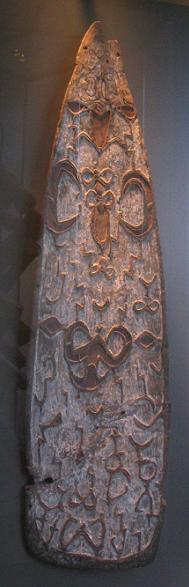
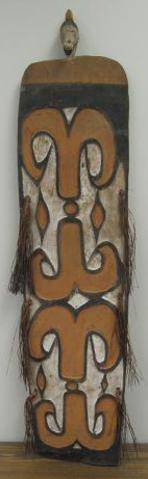
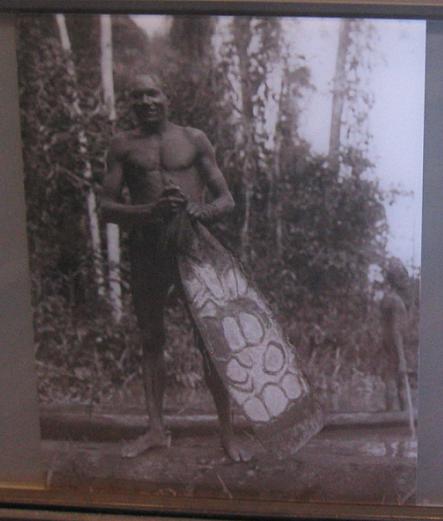
"Shields were prized possessions of Asmat men. Each one was carved from a single piece of mangrove root and named after an ancestor important to the owner. The ancestral spirit then became connected with the object and would help protect the owner from harm, both physical and supernatural. Frequently ... the ancestor's face is abstractly depicted at the top."
* Smidt ed. 1993 p71 (Dirk AM Smidt, "Catalog of woodcarvings" p71-114)
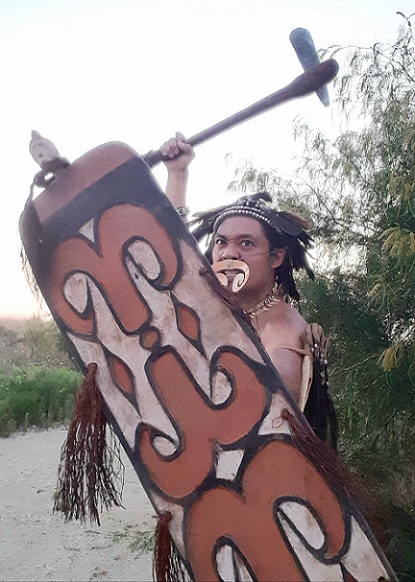
"Asmat shields (jamasj) served a very practical function in warfare, protecting their owner from the spears and arrows of his enemy. But it was not just the thickness of wood that offered this protection . The symbols carved on the shield's surface radiated power, the power of the ancestors, which invigorated the shield's owner and struck fear in his enemies. In battle, a shield was more important than a spear or bow and arrows, even as an offensive weapon. A warrior would rather go into battle without his spear, than without his shield.
"Both shields and figures are named after dead relatives. A single shield, although given only one name, can at the same time refer to more than one dead relative. The shield's namesake is often depicted in the form of a human figure at the top of the shield, at least in the Central Asmat style region. Other more abstract motifs, carved in deep relief on the front of the shield, sometimes refer to other ancestors with which the namesake of the shield had a relationship.
"The magical power of shields gave the carrier exceptional power and courage, adding to the man's own strength the considerable strength of the ancestor after whom the shield is named. At times, particularly during the feasting leading up to raids, the relationship between a man and his shield is such that it is as if the ancestor had literally crawled into the warrior's skin."
* Monbiot 1989 p130
"The carving of shields, drums and paddles, as well as the poles and ancestor figures, is abstract and symbolic, pulling fragments out of life and giving them position and significance. Navels are the centre of everything, and around them are designs based on the intestines of beetles, vaginas of crocodiles, mantids in human form, cuscus tails and hornbills' heads. ... The shields are thought by the Asmat to be so fearsome that they will happily go into battle with them alone and no spears."
* Rogers 1970 p22
"The shields are always made on the occasion of a 'shield festival' and each represents and is named after an ancestor. The shields are made from the plank roots of mangrove trees. They are painted in white prepared from lime, various shades of red, which represents blood, from red earth and black from charcoal. The paints are mixed only with water."
* Eyde 1967 p70
"Asmat shields are five to six feet high and three to four feet wide, tapering toward the bottom. They are also made out of some light wood. The faces are carved with elaborate designs, often representing an abstract outline of a human figure, with a small representation of a head at the top. A ridge of wood with a handle hole runs vertically up the back. Similar shields are made in the course of ceremonial cycles."
" Shields were once an important part of Asmat warfare and headhunting. They are carved with symbols from the natural world, and often colored with bright pigments. Many have a figure at the top representing a loved one who was either killed in a headhunting raid, or a family member who was a great hunter and warrior. The shield gives an Asmat man courage and power in battle, and the symbols cause the enemy to fear them. Shields are carved to honor to a particular ancestor whose spirit is called into it during a special ceremony.
"While warfare no longer occurs, shields are still used in ritual battles and ceremonies. They also are sometimes placed as guards at the rear door of the ceremonial house (Je) when the men are making secret preparations for village rituals. They keep out dangerous spirits, as well as the women and children, until it is time for the ceremonies to begin."
* D'Alleva 1998 p57
"Asmat shields, jamasj, provided both physical and spiritual protection in battle. The symbols carved on the shield make reference to headhunting on numerous levels and radiate ancestral power. Like carved wooden figures, each shield received the personal name of a dead relative, almost always male, who might be portrayed in the finial at the top of the shield. This ancestor then added his power to that of the carrier. A 'shield feast,' or jamasj pokmbu, marked the beginning of a headhunting expedition planned to avenge the deaths of those for whom the shields were named. At the climax of the feast, the shields were placed in a long row in front of the men's house in a dazzling display of artistic and spiritual power."
* Campbell 1991 p134
"Symbolic of the Asmat warrior's strength and power, shields once used in tribal warfare were believed to have magical powers which protected their owners from the enemy. Carved into the shape of a phallus, a shield would be decorated with designs of flying foxes, cassowaries, praying mantises or cuscus tails. Figures of the cockatoo and hornbill, symbolic of headhunting, were also used."
* Pitt Rivers Museum online > Asmat shield (1970.18.1)
"Very large shields like this were also functional and were stood on end in battle, propped against the left shoulder, while the warrior used his bow and arrow from behind them.
... "Jamasj (shields) were among the most highly valued of Asmat artefacts and relate to concepts of masculinity. Shields were always carried by men and were thought to embody one of the owner's dead male relatives. When a man went into battle, he went to avenge the death of the relative embodied in his shield and that relative went with him to assist. Similarly, before a head-hunting mission, shields were carved and presented to the warriors at a Jamasj Pokmbu (Shield Feast). At this feast, the shields were stood to face east, the direction of Safan (the Asmat afterlife), from which the spirit returned to enter the shield."
"The decoration on the surface is considered to be a depiction of the spirit it contains. The central, elongated motif is called bipanew, and represents the pearl-shell ornament that an Asmat head-hunter wore through the pierced septum of his nose. The smaller hooked motifs indicate the tusk of a wild boar, a dangerous animal associated with masculine qualities.
* Weapon 2006 p273
"Each Asmat shield was named after an ancestor and this, along with the design motif, gave the warrior spiritual power and protection. Shields were made of wood and carved with stone, bone, or shell tools. The colors used in the decoration had symbolic significance, red representing power and beauty."
* Benitez/Barbier eds. 2000 p172
"The shields shown on photographs published by Gerbrands all present a black band across the top of the motif, a feature which can also be seen on a photograph taken by Gunther Konrad and published by Nicholas Thomas (1995). On the very tip, there is a schematic anthropomorphic figure, known as 'penis' (tjemen), but also called kawe once it loses its phallic appearance and becomes a likeness of a human being. Below, the curvilinear motifs represent either the 'wings' of the flying fox (tar), or curved nose ornaments made of shell (bipane). Depending on their arrangement, these elements, coloured red and variously combined, can stand for a human figure. Gerbrands speaks of the 'ladder of the ancestors'."
* Chenevière 1987 p103
"The cut-outs on the wooden shield are a stylized version of the bipane. Enforcing the shield's symbolic strength is the ancestor figure carved on top, who offers magic protection."
* Vasem online (describing an Asmat shield, mid-20th century)
"Among the Asmat, war shields are the most powerful symbolic element of a warrior's equipment, and have many layers of meaning. Traditionally, they were functional items used to protect warriors in battle by deflecting an enemy's spears and arrows. The carved and painted images on the surface of the shields were also intended to frighten the enemy and symbolize the power of the ancestors."
* Campbell 1991 p106
"In many cultures the phallic symbol represents male dominance. So it is with the Asmat, who carve the male symbol on their ancestral poles, shields, prows and figures. At one time, to demonstrate dominance over the enemy, the male organ was displayed before an attack."
* Pusaka 1992 134 caption
"In Asmat, Irian Jaya, shields are used not only as defensive weapons but also in funeral ceremonies. ... The human motifs or kafe on the face represent protective ancestors: mother, father and grandfather. The shield can also act as a container for ancestral spirits returning to the material world. The wooden projection, carved in the shape of a human head, could serve as the place of residence of the bearer's own soul."
* Tropenmuseum > Nieuw-Guinea
"War shields were the pride of the warriors of southern New Guinea. They were carved with great care from the prop roots of the mangrove tree. The shields were decorated with carvings and painted motifs intended to frighten the enemy. The depictions were usually of ancestors and animals or objects symbolising head-hunting."
Daggers (Ase Pisua, Ew Karowan)
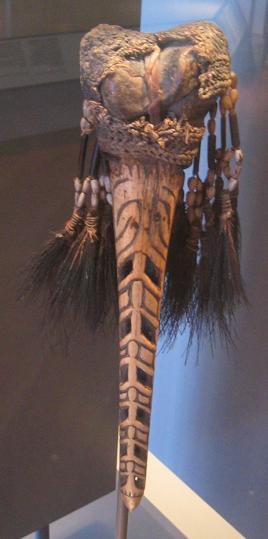
"The Asmat use knives for a variety of purposes, including hunting, stripping bark from trees, and cutting handmade rope. They were also traditionally used as weapons in war and headhunting. Ceremonially, they are brandished by men, and sometimes women, during mock battles.
"Knives are made from the long bones of wild pigs, as well as of bamboo. Their hilts are decorated with tassels of beads and feathers, attached to a woven mesh covering."
* Campbell 1991 p142
"Bone daggers used in battle were made from the jawbone of a crocodile or the shin bone of a cassowary bird. The hilts were trimmed with woven bark string, coix seeds and cassowary feathers."
* Eyde 1967 p70
"Cassowary bone is commonly used to make daggers, ase pisua, used in warfare, village fights, and ritual 'romps' between men and women in the ceremonial cycles. They are about a foot in length. More elaborate daggers, belonging to great warriors, are made of crocodile jaws, ew karowan, or human thigh bones, nanamak. The hilts of the latter two may be decorated with Job's tears, nek, and/or feathers attached to a fine net made of fum twine."
Skull
* Smidt ed. 1993 p20-21 (Dirk AM Smidt, "The Asmat: Life, death and the ancestors" p15-26)
"Enemies were killed in battle, or captured, and killed at special points on the river. The enemy skulls were pierced at the sides with the sharp edge of a stone or a special axe, and the brain was removed. Cooked, either by itself or with the ritually important sago grubs, the brain was eaten to share in the victim's power. After the brains were eaten, enemy skulls were often decorated. The lower jaw was a traditional trinket given by a warrior to his wife or some other woman to wear as a necklace.
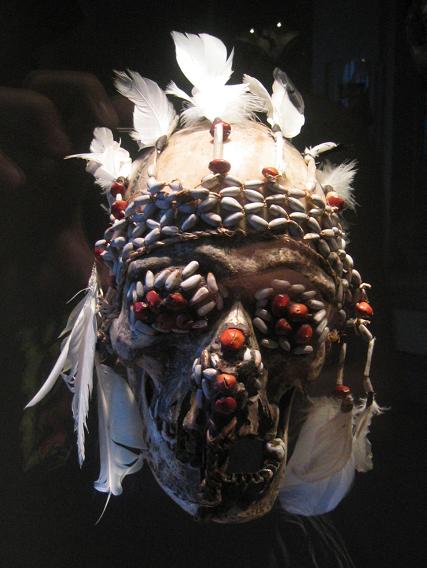
"The skull of a deceased relative was given much more attention. The head, complete with jawbone attached with rattan, was carefully cleaned and decorated. The eye-sockets and nasal cavities were filled with a sticky mixture of beeswax and sap, and set with the shiny gray seeds of the Job's tears grass (Coix lachryma-jobi) and red and black seeds of the crab's-eye vine (Abrus precatorius). A splendid head-dress of cockatoo feathers was often placed round the brow, as if the deceased was about to take part in a dance feast.
"A relative of the deceased will at times wear the skull around his neck, or even use it as a kind of pillow. Such intimate contact with this most powerful talisman insures that the spirit of the deceased will always be around to help the living."
* Campbell 1991 p142
"Ancestor skulls became a part of family life. Worn on the backs or chests of men, or used as pillows, they were a constant reminder of the need to keep in contact with the ancestors. The skulls were decorated with grey coix seeds, red abrus seeds and cassowary feathers."
* Meyer 1995 vI p84 f64
"The skull of the enemy, or ndaokus, was kept as a trophy and as proof of a warrior's prowess. The lower jawbone was given to the women to wear as a necklace -- the ultimate insult -- and there is always a hole in the side of the skull where the brains were taken out to be eaten. The skull of a treasured ancestor, a ndambirkus, was treated with more deference. The lower jawbone was tightly attached to the skull with a woven rattan band. The skulls were dressed in a ceremonial manner. In most cases the eye-sockets were filled with beeswax and inlaid with the grey seeds of Job's-tears grass (Coix lachryma-jobi) or the red seeds of the crab's-eye vine (Abrus precatorius). The nasal cavity was often embellished with a head-hunter's bipane, a spiral shell nose-ornament."
Shell
* Eyde 1967 p25
"Perhaps the most valued of all personal adornments is the triton shell, pirkawor, worn tied to the abdomen at the waist. The wearing of such shells is a privilege of great headhunters. There seems to be a direct association between the triton shell and a taken head. ... The large shells from which these ornaments are made are found only on or near the coast. They are obtained, usually as finished ornaments, through trade by the villages further upstream."
Bag
* Campbell 1991 p144
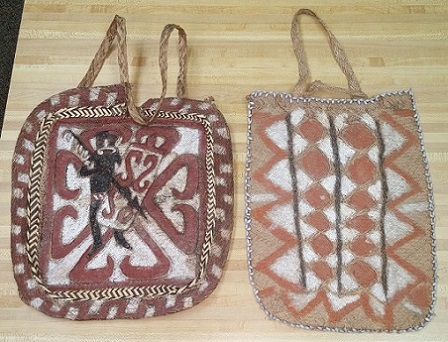
"Bags used by men and women to carry sago starch, firewood and smaller objects are made from dried sago fronds and decorated with feathers, seeds and paint."
* Geary/Xatart 2007 p214-216
"Although unassuming, bilum bags have great cultural significance. Women spend countless hours fashioning them from fiber, creating innovative designs, and using new materials such as cotton and nylon thread. This bag displays geometric patterns, dyed in natural ocher and white, which resemble other Asmat two-dimensional designs. Common throughout New Guinea, bilum bags are versatile utilitarian objects, used to carry everything from food products to babies. They usually display motifs representative of their area of origin and also convey strong mythical and symbolic meanings. In some areas, they serve as dowry and circulate in exchanges that establish and confirm relationships among those involved in the transactions. The bags, which are associated with the identities of their users on the local level, have also become markers of New Guinean cultural identity to the outside world. Logos and written messages appear frequently in the designs of the more contemporary pieces."
Adze / Ax
* Rogers 1970 p20
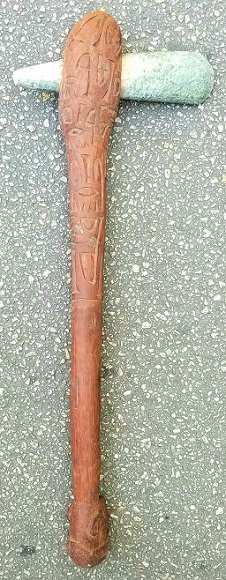
"Stone axes are the woodworking tools."
Archery
* Campbell 1991 p103
"Some of the Asmat are well-versed in the art of magic and sorcery. ... [L]eaves with magical properties are rubbed on an arrow point previously dipped in red ochre and lime paint. Then, when held by the shaft, the arrow will point the way to anything of value which has been lost."
Fetish
* Campbell 1991 p103
"Male sorcery or black magic is centered on a piece of evil-smelling wood. When carved into the shape of a crocodile, rubbed with magical plants and tied to the river bank with pandanus leaves, it will make crocodiles attack and kill any unfortunate person who ventures into, or even near, the river.
"An Asmat told me that for some time a crocodile had persistently preyed on the people of his village when they bathed or fished in the river. After much searching they at last found a carved figure of a crocodile tied to the bottom of a pole in the river, and after it had been destroyed no more people where taken by the crocodile."
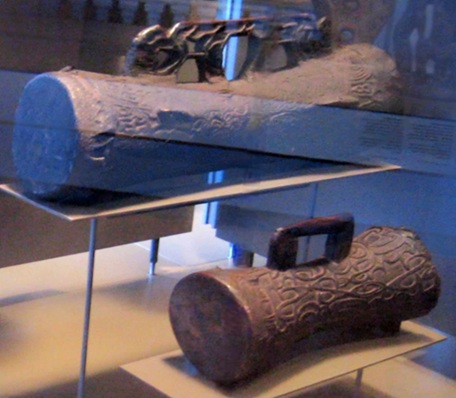
Drum
* Rogers 1970 p20
"Drums are a part of ritual equipment. The drum is shaped like an hour glass with a handle carved from the piece of wood at the constriction in the middle. Drum heads are of lizard skin."
Bowl
*
"