Subject: bagani warrior chief
Culture: Mandaya
Setting: interior Mindanao 19-20thc
Evolution:
Context (Event Photos, Primary Sources, Secondary Sources, Field Notes)
* Harper/Peplow 1991 p537
"Traditionally, small groups of several families lived together, governed by a headman or bagani, usually a warrior who'd killed at least 10 times."
"We know enough — that the bagani figure (badly translated as the English term warrior) was possessed of unusual spiritual power, which was not, like kings, buttressed by an aristocratic hierarchy — to simplify them into the Orang Besár that fascinated historians of island Southeast Asia.
"With this form of leadership recalled, it may also be possible to imagine the word sakop to indicate much more about leadership than we have reduced it to the too simple: to conquer, the conquered.
""The bagani undertook raids, yes; for slaves, yes. But allegiance was accorded him by followers on the basis of that spiritual power; that which is matched in aesthetic/spiritual subtlety by his dagger, shield, spear, and the rest."
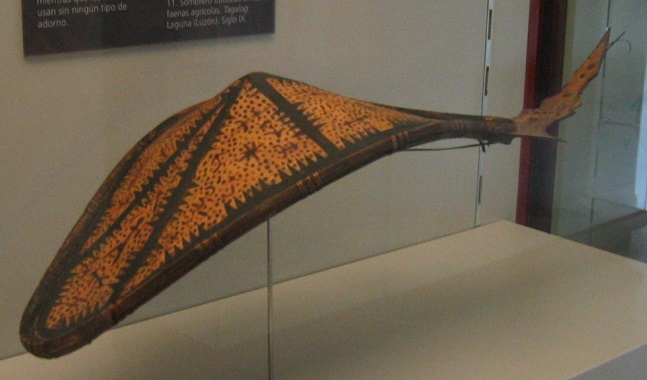
Hat
*
"
Costume
* Harper/Peplow 1991 p538
"Men wore a blue shirt and wide blue or white cotton trousers, both of which may be decorated with embroidery and fringes. Both sexes wear large, heavy pendants, often made from coins; necklaces of beads, teeth, herbs, and seeds; bracelets of brass, shell, or vines; and rings of silver or tortoise shell. The teeth are filed and blackened and the eyebrows shaved to a thin line. ... [O]nly a bagani (headman) may wear an embroidered red suit and a red turban."
Dagger
* Stone 1934 p434-435
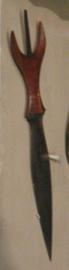
"MANDAYA KNIFE. A knife used by the Mandaya, a Philippine tribe. It has a leaf-shaped, double-edged blade and a wooden hilt with a very deep crescent-shaped pommel. The tang is very long and projects through the hilt between the horns of the pommel. It, and its scabbard, are generally profusely decorated with silver and cane work."
"The badao or winged dagger is a double bladed multi-purpose weapon used by the Mandaya of Eastern Mindanao. The dagger is a status symbol used among the Mandaya datu. It has a crown-like wooden pommel enclosed with a carved wooden sheath provided with red cloth. The red cloth symbolizes bravery among the Mandaya and it is usually seen among Mandaya hunters."
"Called badayaw (or bayadaw) or badáw in the minority language known as Mandaya — also the name of the ethnolinguistic group — the dagger’s name is that of its form. The Mandaya term is a cognate of the Tagalog and Cebuano balaráw. The form — and the word — invariably refers to the short weapon with the leaf-shaped blade.
"This specifically Mandaya version of the lethal and beautiful weapon form were made in the provinces of Davao Oriental and Davao del Norte, Mindanao. Their makers construed themselves, as a distinct people, spatially: as “first people upstream.” This spatiality signals to the Philippine Studies scholar to be keen to the importance of upstream-downstream formulations of identity.
"Within such formulations, beautiful weapons such as these, wielded by Mandaya datus until about a century ago, would have been signals of “upstream” identity vis à vis their others."
Shield
* Benitez/Barbier 2000 p140 (describing a Mandaya shield, Davao Oriental province)
"Single bands of rattan form horizontal lines down the central part and tufts of human hair line the border. The wooden surface is seared with sets of five notches, a feature common to many Mandaya shields."
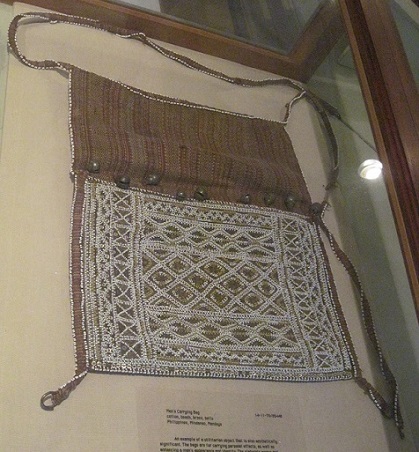
Bag
*
"