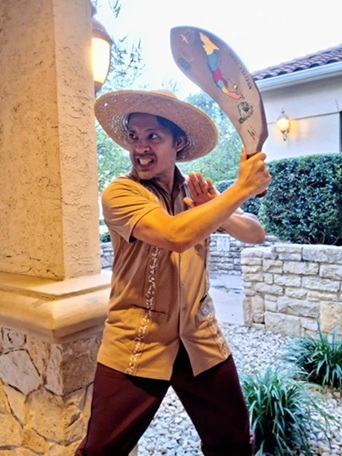
Subject: mambí rebel guerilla
Culture: Cuban
Setting: War of Independence, Cuba mid-late 19thc
Evolution:
Context (Event Photos, Primary Sources, Secondary Sources, Field Notes)
* McNeill 2010 p297-298
"Whereas in 1830 Afro-Cubans accounted for nearly 60 percent of the population, by 1870 they comprised about 40 percent, and only one in four Cubans was a slave. The Cuban elites' eagerness to host the Spanish army diminished accordingly. Now Cuban grievances against Spain weighed more heavily in the balance. Spain taxed Cuba heavily and withheld political rights from Cubans that were granted in Spain itself. Additional taxes imposed to pay for the unsuccessful Spanish war (1861-1865) in the Dominican Republic provided the straw that broke the camel's back. A revolution in Spain in 1868 provided the opportunity. Cubans in the poor and provincial east raised the standard of rebellion in 1868 and soon gathered thousands of slaves and free blacks. For years, Spain was too weak and distracted to do anything much to counter the Cuban rising. But after (yet another) Bourbon restoration in 1875, the divisions among the Cubans told. With the help of many Cubans, especially from the west of the island, the Spanish army restored at least the appearance of the former status quo by 1878. A cordon sanitaire across the narrow waist of the island confined the revolt, known as the Ten Years War, to eastern Cuba, making it easier to stamp out.
"Spain remained poor, committed to costly imperial wars in Morocco, and thus obliged to squeeze Cuba harder than ever. The rise of sugar beet in Europe, in Spain especially, also cut into Cuba's sugar exports and thus its prosperity. The U.S. market for sugar briefly came to the rescue, but in the 1890s new tariffs, the emergence of Hawaiian and Louisiana sugar, and an international depression combined to put the Cuban economy into crisis. Two particularly damaging hurricanes added to the misery. Nationalist-minded intellectuals found ever more reasons to deny Spain's right to govern Cuba. In 1895, another rebellion broke out.
"The rebellion arose in the backward eastern part of the island, led by veterans of the Ten Years War, notably the ex-Spanish officers Máximo Gómez (1836-1905) and the Afro-Cuban Antonio Maceo (1845-1896). Born in Santo Domingo, Gómez had fought for Spain in Caribbean wars as a young man, but in 1868 had thrown in with Cuban revolutionaries and now fought at their head in his early sixties. Maceo was one of many exiled revolutionaries who hurried back to Cuba to join the insurrection. His father, a white Venezuelan, had fought in Bolívar's was before moving to Cuba. Both Gómez and Maceo proved themselves skilled guerilla commanders, and utterly merciless in pursuit of their goals. With no more than a few thousand ill-armed, ill-clad, ill-fed men under their command at any single time, they could ill afford pitched battles with the Spanish army; in their two most famous victories they killed fewer than a hundred Spaniards. The rebels had more horses and greater mobility than the Spanish forces, and could when necessary melt away into the general population. But little else stood in their favor, so they resorted to a war of ambush, massacre, and the torch. They burned the towns and plantations wherever they could, in an effort to destroy Cuba's economy and its value to Spain. They sought to force men to join the rebellion by depriving them of their livelihoods and sustenance. Most who joined were Afro-Cubans, young and unmarried, with little to lose. Perhaps 40,000 men served in the insurgents' armies over the course of three years, but no more than a fraction of this total at any one time. Cubans fought on both sides; more fought for Spain than for independence.
"Militarily the mambises, as they came to be known, posed little risk to the Spanish army, but politically they prevailed. They marched from east to west almost the length of the island, burning as they went. They goaded the Spaniards into unpopular policies, courted foreign support -- especially the U.S. -- and, most of all, used their mobility to avoid Spanish forces except when they found patrols in vulnerable situations. Thus they kept their rebellion alive, like Washington, Toussaint, and Bolívar before them, and emerged victorious because time and the 'climate' was [SIC] on their side."
* de Quesada/Walsh 2007
"
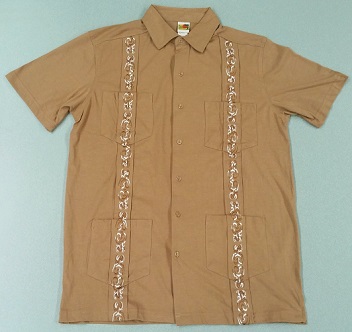
Costume
* Fogg ed. 2013 p140
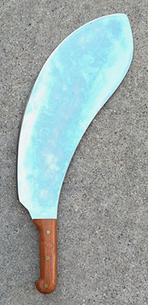
Machete
* Sharpe 2012 p20
"The machete ... was originally used for clearing foliage in jungle areas, but could easily be relied upon as a weapon. The machete was used in uprisings and rebellions such as that in Cuba against the Spanish rule."
"Machetes ... played a prominent role in the Cuban Wars of Independence.... In these liberation struggles, Afro-Cubans soldiers often dominated the ranks. The main Cuban tactic, like that of the Haitian revolutionaries, was stealthy rifle attacks against the Spanish from concealed positions. According to one Spanish source, "their main tactic was to fire from positions behind trees or broken terrain" and quickly disperse in skirmishes. Yet it was the Cuban use of the machete by black troops that terrified Spanish soldiers. The Spanish were armed with Mausers, deemed the best rifles in the world at the time. They were repeating rifles with greater accuracy and four times the range of the Remington rifle used by the Cubans. As a result, even with their guerilla tactics, Cuba"s concealed marksmen were at a disadvantage in terms of accuracy. Antonio Maceo opened up the most important battles after Maltiempo, including Peralejo and Iguara, with machete charges. These shock tactics forced Spanish soldiers to close their ranks into tight squares. This defensive positioning into massed squares made the Spanish troops much easier targets for the Cubans firing from concealed positions with the less accurate Remingtons.
"However, the machete came into play most prominently in the battle of Maltiempo, the greatest Cuban victory over the Spanish and certainly the bloodiest. The Cubans at Maltiempo were, like the Haitians at La Crete a Pierrot, running out of ammunition. However, by making a decisive machete attack they were able to soundly defeat the Spanish forces, many of whom were newly arrived recruits easily unnerved by machete assaults. The Spanish troops were armed with sabers, giving them a theoretic advantage since they had guarded handles, thrusting points as well as a much longer blade than a machete. Yet the Cubans inflicted a bloody defeat on them. According to Montejo:
'They went crazy when they saw us, and they threw themselves into the thick of it, but the fight didn't last long because at almost the same instant we started to chop off their heads. But really chopping them off. The Spaniards were scared shitless of the machetes. They weren't afraid of rifles, but machetes, yes. I raised mine, and from a distance said: "you bastard, now I'm going to cut your head off.'
"After the battle, the field was strewn with severed heads."