Subject: سردار sardar military nobleman
Culture: Afghan
Setting: Afghanistan late 19th-early 20thc
Evolution:
Context (Event Photos, Primary Sources, Secondary Sources, Field Notes)
*
"
Sabers
* Macaraeg 2023-01-23 lecture
"A particular form of saber with western stylistic elements evolved in tandem with the westernization of male costume among the Afghan military nobility. From surviving examples it appears that these were made both in state armories and local workshops, following a regulation pattern whose specifications were, for the most part, closely followed. The hilt has an angular pommel with a clear resemblance to the shamshir saber hilt popular across Persia and Sindh in the 18th and 19th centuries. Other features differ noticeably from Persian and Hindustani sabers. Blades are straighter, shorter, and wider. A narrow branched knucklebow joins the small guard to the pommel.
"Judging from contemporaneous photos, this new saber did not entirely replace existing native saber types. I suspect this is because the new saber's proportions meant that it was a substantially different weapon from traditional sabers, not compatible with native fencing techniques. Further, this was happening at a time when edged weapons were rapidly becoming obsolete, with sabers being relegated to ceremonial roles."
Costume
* Macaraeg 2023-01-23 lecture
"Descriptions of the appearance of Afghan men over the decades of British military action in Afghanistan from the 1840s to 1910s were simple and consistent, another example of the "ethnographic present" in colonial narratives. Yet over this time span, we do see Afghan arms and costume change, as we would logically expect to happen during changing times.
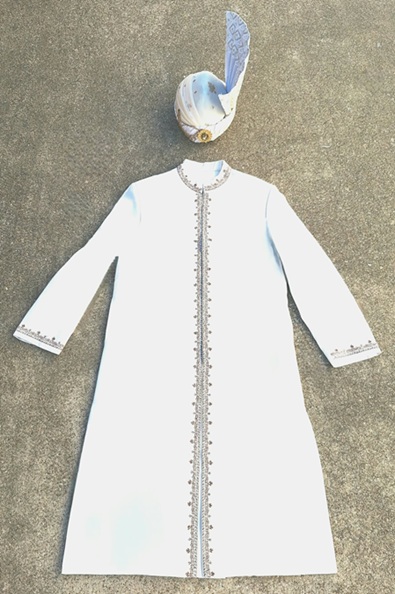
"This is most readily seen with the Afghan military nobility. From photos preserved in the British Library and National Army Museum, we see men of rank adopting items of western dress, particularly military and civilian frock coats, and buttoned tunics of the kind becoming popular in British India at the time -- the 'Raj pattern.' The overall sartorial effect was very similar to analogs among contemporaneous Indian Hindus and Muslims, Malays in British Malaya, and Javanese in the Dutch East Indies, among others: Superimposed on traditional masculine costume, the western frock and tunic projected a western silhouette while leaving native elements such as headwear intact in order to retain native signifiers of rank and status."
Bottle
*
"