Subject: ahadi 'single' heavy cavalryman
Culture: Mughal-Rajput
Setting: Great Mughal empire, Hindustan/Deccan late 16th-early 18thc
Brooklyn Museum > South and South-East Asia *
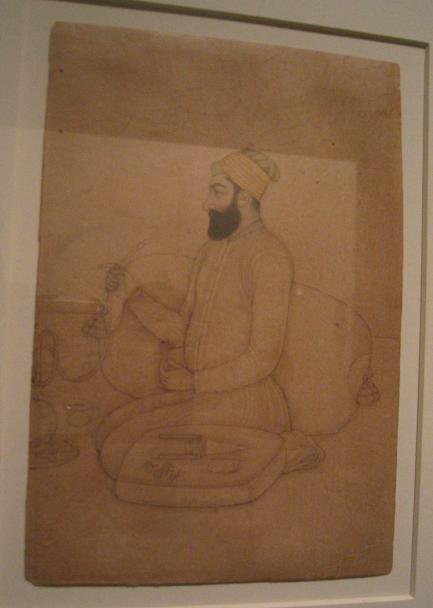
"Hardas, Son of Anup Chatar (Indian, active 17th century) Portrait of a Man India, Aurangzeb period, late 17th century Color wash on paper ...
Reclining against a large pillow, a bearded man with a turban holds a huqqa pipe in his right hand and a flower in his left.
On the cushion next to him are a dagger and more flowers. The sitter's name is not provided,
but inscriptions on the reverse indicate that he had previously been a trustworthy imperial soldier,
that he might have been born in the Deccan region of central India,
and that he was an official of the court of the Mughal emperor Aurangzeb in charge of music and other performing arts.
The profile in this portrait was probably used by court artists as a template to add the sitter to scenes commemorating royal events."
* Higgins Armory Museum > Scimitars to Samurai
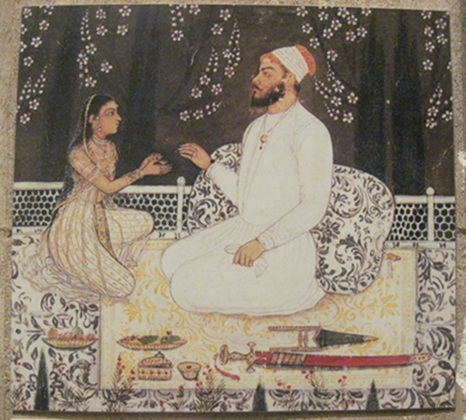
"Couple on a terrace Detail from an Indian (Deccan school) miniature, about 1750 From the original in the Musée Guinet [SIC], Paris"
Chester Beatty Library *
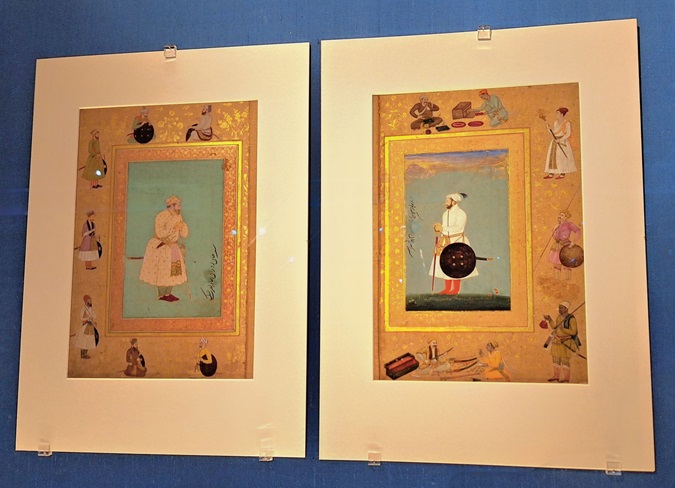
"Facing Pages Two folios from the Minto Album Paintings by Hashim (left) and Govardhan (right) Borders signed Harif (right) c. 1620, Agra, India ... When an album is assembled, different artworks face one another on every page-opening.
The borders unite the arrangement, by following a single design.
"These deep blue borders are painted with gold garden details of flowering plants and flying insects. On the left is a formal portrait of Shahnavaz Khan Safavi (d. 1659), whose family came to India from Iran. Shah Jahan wrote a note about him on the left margin.
"On the right is a lightly-painted scene of travellers resting at an encampment, enjoying music together."
* Dallas Museum of Art > Paradise on Earth: Florals in Indian Textiles
"Portrait of a Nobleman Holding a Pink Rose 1600-1700, Mughal period India Opaque watercolor on paper
According to the Akbarnama, the historical narrative of Mughal emperor Akbar's reign, the main item of court dress for men was a long robe (jama) with a diagonal tied fastening, a style that came originally from Central Asia. Woven or embroidered patterned silk and printed cotton textiles were used for both upper garments and trousers, and decorative sashes (pakta), often made of lavish silk and gold, were tied around the waist. Men's robes made of block-printed cotton were popular in both Muslim and Hindu courts and appear in paintings from the 17th century onward, as shown here. This nobleman holds a single rose that signifies his grace, cultured ease, and sophisticated taste." ...
"Retrato de un noble con una rosa rosada en la mano 1600-1700, período mogol India Acuarela opaca sobre papel
Según el Akbarnama, la historia del reinado del emperador mogol Akbar, la prenda principal del atuendo de la corte para los hombres era una túnica larga (jama) con un cierre diagonal atado, un estilo que provenía originalmente de Asia central. Para las prendas superiores y los pantalones se utilizaban tejidos de seda con diseños bordados y estampados y textiles de algodo'n estampados, y alrededor de la cintura se ataban fajines decorativos (patka), a menudo confeccionados con lujosas sedas y oro. Las túnicas masculinas de algodón estampado con bloques eran populares tanto en las cortes musulmanas como en las hindúes y aparecen en pinturas a partir del siglo XVII, como se musetra aquí. Esta noble sostiene una sola rosa que simboliza su elegancia, su comodidad culta y su sofisticado gusto." ...