Subject: riddare knight
Culture: Scandinavian
Setting: Kalmar Union 15-16thc
Context (Event Photos, Primary Sources, Secondary Sources, Field Notes)
* Historiska > Riddare på medeltiden 2025-11-10 online
"Riddare var de i adeln som slogs till häst, särskilt under medeltiden, från 1000-talet och framåt. ....
"Redan på vikingatiden fanns det rika bönder och ledare i byarna med makt. Med tiden blev de en speciell grupp i samhället som kallades “frälse”, eller adeln. De hade fler rättigheter än vanliga människor. Gruppen som jobbade nära kungen, kallades hirden. De fick också fördelar, i utbyte behövde de hjälpa kungen i krig med hästar och soldater.
"Den största fördelen som adeln hade var att de slapp betala skatt till kungen. De fick också ta emot böter från bönderna som bodde och arbetade på deras mark. Men om en adelsman inte kunde visa att han hade en häst och en soldat som kunde hjälpa kungen i krig, kunde han förlora sina fördelar."
* Histoiska > Knights in the Middle Ages 2025-11-10 online
"Knights were members of the nobility who fought on horseback, particularly during the Middle Ages from the 11th century onwards. ....
"Already in the Viking Age there were wealthy farmers and village leaders who held considerable power. Over time they became a distinct social group known as the frälse, or nobility. They enjoyed greater rights than ordinary people.
"Another group, known as the hird, worked closely with the king. In return for privileges, they were obliged to support him in war with horses and soldiers. Knights were members of the nobility who fought on horseback, especially during the Middle Ages from the eleventh century onwards.
"The greatest privilege of the nobility was exemption from paying taxes to the king. They also received fines from the peasants who lived and worked on their estates. However, if a nobleman could not prove that he kept a horse and soldier ready to assist the king in war, he risked losing his privileges."
Costume
* El Quijote en sus trajes 2005 p60 (Lena Rangström, "Suecos en traje español" p59-73)
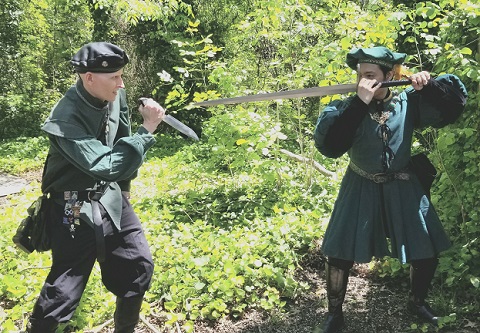
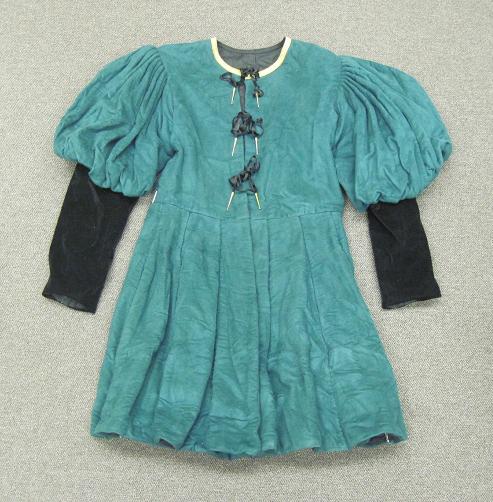
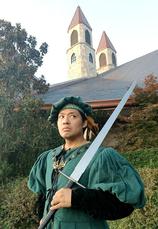
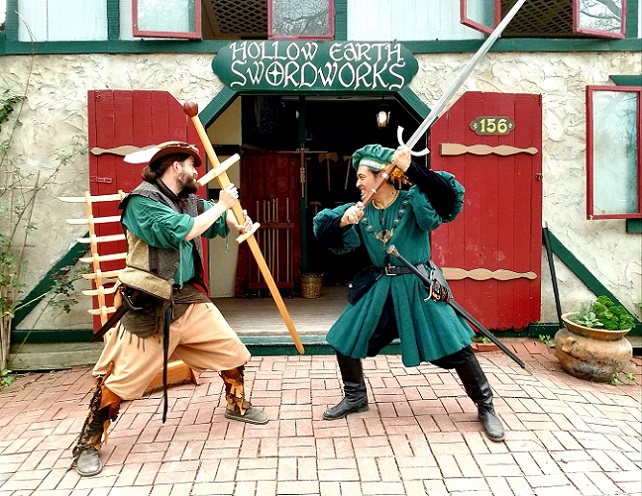
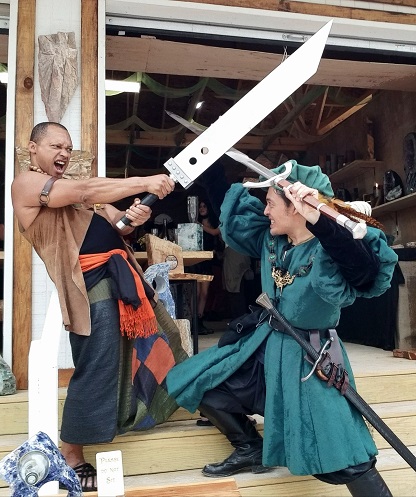
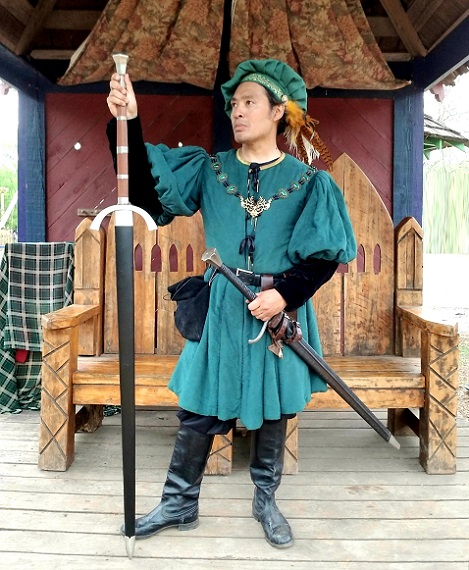
"La dinastía Vasa coincidió con una nueva moda europea. Por primera vez se divulgó un estilo común, constituido por ingredientes de las diferentes naciones, que se influían mutuamente en una constante interacción. España, con su brillante poderío, político, adquirido a partir de los prestigiosos descubrimientos de Colón a finales del siglo XV, tuvo una fuerte influencia sobre el gusto en el vestir. Desde mediados del siglo XVI y hasta los primeros años del XVII, la estética española marcó la pauta en las cortes europeas
Sword
* Norman 1964 p104-105
"Le long espadon du XIVe siècle devient de plus en plus populaire dans le nord de l'Europe au cours du XVe siècle, atteignant de très grandes dimensions au siècle suivant. Il est employé à la fois comme arme destinée aux hommes les plus forts désignés pour monter la garde, et à des fins cérémoniales, comme il l'est encore aujourd'hui. L'épée nordique à deux mains est réservée presque uniquement à la taille. La lame peut être utilisée raccourie en la saisissant de la main en avant des quillons."
* Melville 2018 p61-62
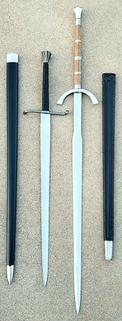
"Danish swordsmiths produced two-handed swords in two quite different and unique styles, though since Norwegian and Swedish smiths produced very similar swords perhaps we should refer to their products as Scandinavian. The three countries were officially united under a single monarch according to the Union of Kalmar from 1397 until 1523, though there were frequent rebellions and temporary secessions by one or other of the countries. The most unusual of these styles, totally different from any other style of sword hilt, seems to have more Danish examples than other Scandinavian ones .... The blades are broad, flat, taper regularly from crossguard to modest point with no ricasso and are on the short side for two-handed swords at around 100cm (around 140cm overall so the hilts are comfortably two-handed); the pommels are wheel-shaped or thick, flat disks, but the crossguards are extraordinary: round bars issue from the quillon block, turn towards each other in the horizontal plane, turn away before meeting and continue round the back of the block where they meet, intertwine and pass over some of the internal space before finishing up welded to an intermediate part of the circuit. This is sometimes described as 'pretzel' shaped, but that does not do justice to this intricate arrangement and its variations. All these swords can be dated to the last quarter of the fifteenth century, while the rough-and-ready hiltwork and less than top quality blades seem to suggest locally furbished imported blades intended to equip local troops.
"The second style appears on swords with Norwegian and Swedish provenance, but more often again on ones with a Danish provenance, and there are two variations, but they have very long grips, many stretching to almost half the length of the blade, octagonal-facetted, pear-shaped pommels and slim, tapering blades with sharp points, well suited to thrusting at weak spots in armour. One variation has a flat crossguard, usually strongly arched, almost curved into a semicircle, and a long ricasso which is definitively narrower than the forte of the blade. The other variation can be divided into three sub-variations. The main one has a flat crossguard, sometimes flaring towards the ends and only moderately curved, and the sword has no noticeable ricasso. The second sub-variation has a crossguard where both quillons curve horizontally to the same side, the so-called 'C' guard, and the third has quillons recurved in the vertical plane. The surviving grip of one sword has a series of metal bands between cross and pommel, either to strengthen it or to provide a better purchase for the hands. Length overall ranges from 140cm to 155cm, with blades around the 100cm mark. There are a few larger than this and one, over the tomb of King Christian I, that is smaller. Marks indicating an origin in Passau have been noted on some blades. Swords of this style seem to have been made during most of the fifteenth century, but particularly in the second half, to judge from the altarpieces of this period, which picture various saints holding these swords."
Armor
* Historiska > Riddare på medeltiden 2025-11-10 online
"En riddares rustning var avancerad för sin tid. I början hade de mest ringbrynja, ett tätt vävt nät av metallringar av järn eller stål. Sedan började man använda plåtar av hårt stål som skyddade ännu bättre. På 1400-talet fanns det rustningar som täckte hela kroppen och passade perfekt för varje riddare."
* Histoiska > Knights in the Middle Ages 2025-11-10 online
"A knight’s armour was highly advanced for its time. Early on, knights wore mail shirts – tightly woven chains of iron or steel rings. Later, plates of hardened steel came into use, offering even greater protection. By the fifteenth century, full suits of armour existed that covered the entire body and were tailor-made for each knight."