Subject: knight, man-at-arms
Culture: English
Setting: Wars of the Roses, England mid-late 15thc
Context (Event Photos, Primary Sources, Secondary Sources, Field Notes)
"The Wars of the Roses were the wars of ‘bastard feudalism’. By the 15th century, war was almost completely professionalised. Most knights had evolved into peace-loving local gentry – ‘lords of the manor’ in their villages, but no longer lords of battle, having commuted their inherited obligations to do military service for money payment, an arrangement that well-suited their overlords, who wanted funds for aristocratic display and professional retainers.
"Many knights, of course, continued to be military men, but this was now a choice, and others gained the rank through service as professional captains. Such men were commonly sub-contractors, who would hire, equip, and train a contingent of armed men, whose services they would then sell. This development meshed with the growing desire of leading magnates – who were competing with each other for offices, estates, and court influence – to monopolise the service of these military contingents by engaging them in long-term contracts.
"The system originated at the top. During the 14th century, Edward III had revolutionised the English system for raising royal armies by replacing reliance on feudal obligation with written indentured contracts between the Crown and leading magnates for the performance of military service. These magnates then set about building what were, in effect, private armies.
"Those who sold themselves to a particular lord on a long-term basis would wear his ‘livery’ (heraldic colours and devices) in return for ‘maintenance’ (payment and protection): these were the true ‘retainers’, since they were paid even when not on active service.
"Only professionals could sell themselves in this way, and the rewards for skilled archers, spearmen, and men-at-arms were high. In 1467, Sir John Howard hired an archer by offering him £10 a year (the income of a knight), two gowns, and a house for his wife. As a sign-up bonus, he also provided a payment of 2s. 8d., two doublets, and new livery coat.
"Also notable is the fact that all soldiers seem to have worn plentiful armour, and to have been mounted on campaign. Medieval armour was, of course, hugely expensive, as were the horses to provide mounts for archers as well as men-at-arms. Yet contemporary images leave little room for doubt: we see archers wearing steel sallets, chainmail shirts, quilted jacks, plate on arms and legs, and mounted on the march."
Polearm
* Royal Armouries Museum > War Gallery
"The characteristic weapon of the English heavy infantry of the 15th century was the bill, used in the same way as the halberd on the continent. Originally an agricultural implement, military versions were being made by the late 13th century." ...
Longsword
*
"
Armor
"The ‘battle’ would therefore fly the standard of the great lord, and the numerous banners of the individual leaders forming his affinity. Each man-at-arms would wear a surcoat decorated with the badge and livery of his lord, sometimes that of the great lord himself, often that of his own captain, if he were of sufficient rank. Looking on such a battle, therefore, one would see an array of men encased in plate armour amid the reds and yellows, blues and greens, whites and blacks of countless heraldic devices.
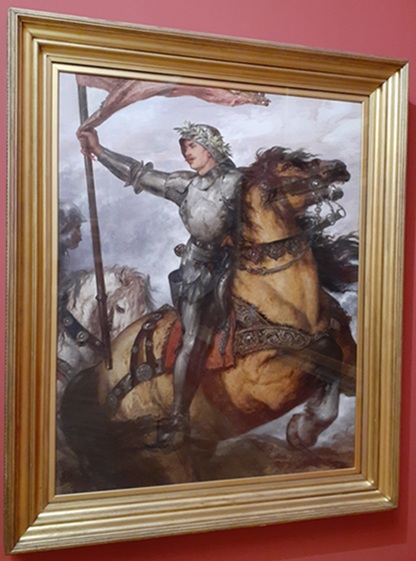
"During the 15th century, the comprehensiveness of body armour reached a peak. A well-equipped man-at-arms would wear steel plate-armour that covered head, shoulders, arms, hands, torso, thighs, legs, and feet. Ideally, the plates would comprise many small pieces strapped together, so as to allow maximum movement, and the best armours would be so fully articulated that they imposed very little restriction. Plate was designed with angled surfaces to deflect arrows and blows from hand-held weapons."
* Woosnam-Savage 2017 p63
"English armours had tassets attached higher on the fauld, gentle fluting on the armour for the limbs and big bold 'besagews' with pronounced florid edges and rivet heads."
Dagger
*
"
Costume
* Köhler 1928 p174-175
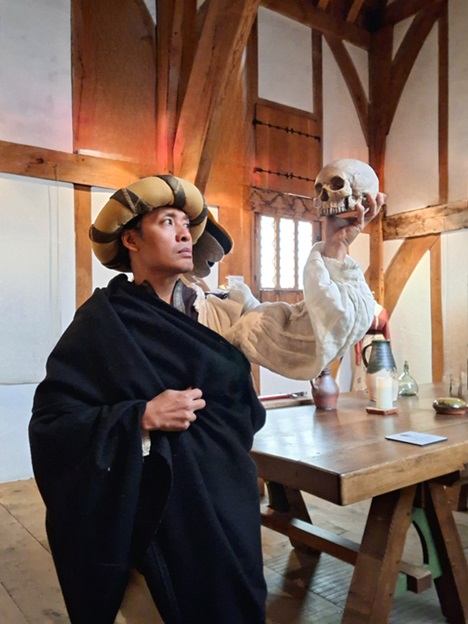
"About the middle of the fifteenth century the items of attire commonly worn in France were brought from the Court of Burgundy into England. These included the tabard, wholly or partially open at the sides, and the robe, of varying length, closed all round and pleated round the waist. One of the chief importations was the fashion of thickly padded shoulders. English fashion also adopted the 'slashed' style that had gained currency in France during the second half of the century. By all kinds of ornamentation, including embroidery on the breeches, the English imparted to their dress a motley appearance that surpassed that attained by the introduction of mi-parti.
"Like that of the Frenchmen, the dress of Englishmen took on a different character toward the end of the century. The slashings increased both in number and in size, and the long, wide-sleeved over-garments had broad turned-down collars of fur, which ere long appeared also on the shorter overcoats. These latter had often very long sleeves, which, like those of the longer overcoats, were slashed either longitudinally or across. The close-fitting, low-necked undercoats were shortened and transformed into jackets, and in place of the padded shoulders came large puffs reaching to the elbows. The puffs were likewise slashed.
"These puffed sleeves were made as follows. They were cut straight, but much longer and much wider at the sleeve-hole than the ordinary sleeve. The upper parts of these sleeves were slashed either to the edge of the material or to some little distance from it. When the sleeves were sewn in other sleeves were inserted as lining. These were cut wide and slightly padded, and were sewn to the sleeve-hole along with the outer sleeves.
"Englishmen's dress was even more gaily coloured than that of Frenchmen, for in addition to wearing over their close-fitting breeches shorter breeches striped in different colours and extending to the middle of the thigh, they also wore stockings that came up higher than the calf of the leg.
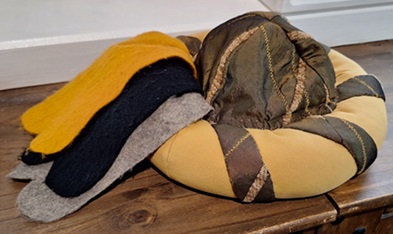
"An important part of male attire was a round, wide-brimmed hat, mostly turned up at one side, with a large plume. A small skull-cap was worn beneath it. This was a genuinely French fashion, as were all the other forms of headgear -- hats and caps -- that came into use in England during this century.
"Changes had also taken place in footwear. About the year 1480 the long, pointed shoes disappeared, and boots and shoes became rounder at the toes. About the year 1500 the round toes were replaced by broad ones. Tight-fitting boots, knee-high, and turned over at the top, were at this time as popular in England as the over-stockings ...."
Arming Sword
*
"